Array factor
From Wikipedia, the free encyclopedia
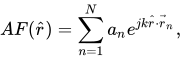
In the study of antennas, the array factor is a mathematical function that describes the signal of an antenna array as a combination of the signals of its individual antennas. More precisely, the array factor is multiplied by the radiation pattern of an individual antenna to produce the pattern of the entire array. This difference in the patterns is due to the constructive and destructive interference properties of radio waves.
The array factor depends on
- the positions of the individual antennas in the array,
- the complex weights (amplitudes and phases) being used to combine (or excite) the signals of the antennas, and
- the direction of signal arrival (or transmission).
When the antenna weights are chosen appropriately, then the array factor has large magnitude for signals in the desired direction(s) and small in the direction(s) that the array operator wants to ignore. This is how the beam of a phased array is steered.