Askey–Gasper inequality
From Wikipedia, the free encyclopedia
In mathematics, the Askey–Gasper inequality is an inequality for Jacobi polynomials proved by Richard Askey and George Gasper (1976)[1] and used in the proof of the Bieberbach conjecture.
Statement
For and ,


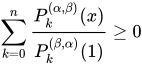

where is a Jacobi polynomial.

The case when can also be written as


In this form, with α a non-negative integer, the inequality was used by Louis de Branges in his proof of the Bieberbach conjecture.[2]
Proof
Ekhad gave a short proof of this inequality in 1993,[3] by combining the identity

with the Clausen inequality.
Generalizations
Gasper and Rahman (2004)[4] give some generalizations of the Askey–Gasper inequality to basic hypergeometric series.