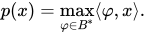
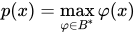
Asymmetric norm
From Wikipedia, the free encyclopedia
In mathematics, an asymmetric norm on a vector space is a generalization of the concept of a norm.
An asymmetric norm on a real vector space is a function that has the following properties:


- Subadditivity, or the triangle inequality:
- Nonnegative homogeneity: and every non-negative real number
- Positive definiteness:




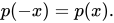
Asymmetric norms differ from norms in that they need not satisfy the equality
If the condition of positive definiteness is omitted, then is an asymmetric seminorm. A weaker condition than positive definiteness is non-degeneracy: that for at least one of the two numbers and is not zero.


Examples
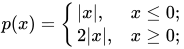
On the real line the function given by is an asymmetric norm but not a norm.

In a real vector space the Minkowski functional of a convex subset that contains the origin is defined by the formula for . This functional is an asymmetric seminorm if is an absorbing set, which means that and ensures that is finite for each