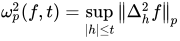
Besov space From Wikipedia, the free encyclopedia Generalization of Sobolev spaces In mathematics, the Besov space (named after Oleg Vladimirovich Besov) B p , q s ( R ) {\displaystyle B_{p,q}^{s}(\mathbf {R} )} is a complete quasinormed space which is a Banach space when 1 ≤ p, q ≤ ∞. These spaces, as well as the similarly defined Triebel–Lizorkin spaces, serve to generalize more elementary function spaces such as Sobolev spaces and are effective at measuring regularity properties of functions. Several equivalent definitions exist. One of them is given below. This definition is quite limited because it does not extend to the range s ≤ 0. Let Δ h f ( x ) = f ( x − h ) − f ( x ) {\displaystyle \Delta _{h}f(x)=f(x-h)-f(x)} and define the modulus of continuity by ω p 2 ( f , t ) = sup | h | ≤ t ‖ Δ h 2 f ‖ p {\displaystyle \omega _{p}^{2}(f,t)=\sup _{|h|\leq t}\left\|\Delta _{h}^{2}f\right\|_{p}} Let n be a non-negative integer and define: s = n + α with 0 < α ≤ 1. The Besov space B p , q s ( R ) {\displaystyle B_{p,q}^{s}(\mathbf {R} )} contains all functions f such that f ∈ W n , p ( R ) , ∫ 0 ∞ | ω p 2 ( f ( n ) , t ) t α | q d t t < ∞ . {\displaystyle f\in W^{n,p}(\mathbf {R} ),\qquad \int _{0}^{\infty }\left|{\frac {\omega _{p}^{2}\left(f^{(n)},t\right)}{t^{\alpha }}}\right|^{q}{\frac {dt}{t}}<\infty .} Norm The Besov space B p , q s ( R ) {\displaystyle B_{p,q}^{s}(\mathbf {R} )} is equipped with the norm ‖ f ‖ B p , q s ( R ) = ( ‖ f ‖ W n , p ( R ) q + ∫ 0 ∞ | ω p 2 ( f ( n ) , t ) t α | q d t t ) 1 q {\displaystyle \left\|f\right\|_{B_{p,q}^{s}(\mathbf {R} )}=\left(\|f\|_{W^{n,p}(\mathbf {R} )}^{q}+\int _{0}^{\infty }\left|{\frac {\omega _{p}^{2}\left(f^{(n)},t\right)}{t^{\alpha }}}\right|^{q}{\frac {dt}{t}}\right)^{\frac {1}{q}}} The Besov spaces B 2 , 2 s ( R ) {\displaystyle B_{2,2}^{s}(\mathbf {R} )} coincide with the more classical Sobolev spaces H s ( R ) {\displaystyle H^{s}(\mathbf {R} )} . If p = q {\displaystyle p=q} and s {\displaystyle s} is not an integer, then B p , p s ( R ) = W ¯ s , p ( R ) {\displaystyle B_{p,p}^{s}(\mathbf {R} )={\bar {W}}^{s,p}(\mathbf {R} )} , where W ¯ s , p ( R ) {\displaystyle {\bar {W}}^{s,p}(\mathbf {R} )} denotes the Sobolev–Slobodeckij space. References Triebel, Hans (1992). Theory of Function Spaces II. doi:10.1007/978-3-0346-0419-2. ISBN 978-3-0346-0418-5. Besov, O. V. (1959). "On some families of functional spaces. Imbedding and extension theorems". Dokl. Akad. Nauk SSSR (in Russian). 126: 1163–1165. MR 0107165. DeVore, R. and Lorentz, G. "Constructive Approximation", 1993. DeVore, R., Kyriazis, G. and Wang, P. "Multiscale characterizations of Besov spaces on bounded domains", Journal of Approximation Theory 93, 273-292 (1998). Leoni, Giovanni (2017). A First Course in Sobolev Spaces: Second Edition. Graduate Studies in Mathematics. 181. American Mathematical Society. pp. 734. ISBN 978-1-4704-2921-8 vteFunctional analysis (topics – glossary)Spaces Banach Besov Fréchet Hilbert Hölder Nuclear Orlicz Schwartz Sobolev Topological vector Properties Barrelled Complete Dual (Algebraic / Topological) Locally convex Reflexive Separable Theorems Hahn–Banach Riesz representation Closed graph Uniform boundedness principle Kakutani fixed-point Krein–Milman Min–max Gelfand–Naimark Banach–Alaoglu Operators Adjoint Bounded Compact Hilbert–Schmidt Normal Nuclear Trace class Transpose Unbounded Unitary Algebras Banach algebra C*-algebra Spectrum of a C*-algebra Operator algebra Group algebra of a locally compact group Von Neumann algebra Open problems Invariant subspace problem Mahler's conjecture Applications Hardy space Spectral theory of ordinary differential equations Heat kernel Index theorem Calculus of variations Functional calculus Integral linear operator Jones polynomial Topological quantum field theory Noncommutative geometry Riemann hypothesis Distribution (or Generalized functions) Advanced topics Approximation property Balanced set Choquet theory Weak topology Banach–Mazur distance Tomita–Takesaki theory Category Related Articles~TimelinesTop QsFact Checks
 is equipped with the norm
 coincide with the more classical Sobolev spaces
  .
. and
and  is not an integer, then
  , where
  denotes the Sobolev–Slobodeckij space.