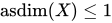
Asymptotic dimension
From Wikipedia, the free encyclopedia
In metric geometry, asymptotic dimension of a metric space is a large-scale analog of Lebesgue covering dimension. The notion of asymptotic dimension was introduced by Mikhail Gromov in his 1993 monograph Asymptotic invariants of infinite groups[1] in the context of geometric group theory, as a quasi-isometry invariant of finitely generated groups. As shown by Guoliang Yu, finitely generated groups of finite homotopy type with finite asymptotic dimension satisfy the Novikov conjecture.[2] Asymptotic dimension has important applications in geometric analysis and index theory.
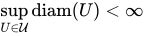
Let be a metric space and be an integer. We say that if for every there exists a uniformly bounded cover of such that every closed -ball in intersects at most subsets from . Here 'uniformly bounded' means that .


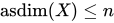


We then define the asymptotic dimension as the smallest integer such that , if at least one such exists, and define otherwise.



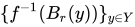
Also, one says that a family of metric spaces satisfies uniformly if for every and every there exists a cover of by sets of diameter at most (independent of ) such that every closed -ball in intersects at most subsets from .


Examples
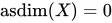
- If is a metric space of bounded diameter then .
- .
- .
- .



Properties
- If is a subspace of a metric space , then .
- For any metric spaces and one has .
- If then .
- If is a coarse embedding (e.g. a quasi-isometric embedding), then .
- If and are coarsely equivalent metric spaces (e.g. quasi-isometric metric spaces), then .
- If is a real tree then .
- Let be a Lipschitz map from a geodesic metric space to a metric space . Suppose that for every the set family satisfies the inequality uniformly. Then See[3]
- If is a metric space with then admits a coarse (uniform) embedding into a Hilbert space.[4]
- If is a metric space of bounded geometry with then admits a coarse embedding into a product of locally finite simplicial trees.[5]