Atapuerca Mountains
Mountain range in northern Spain
From Wikipedia, the free encyclopedia
The Atapuerca Mountains (Spanish: Sierra de Atapuerca) is a karstic hill formation near the village of Atapuerca in the province of Burgos (autonomous community of Castile and Leon), northern Spain.
Sierra de Atapuerca | |
 Atapuerca Mountains panorama | |
  Atapuerca Mountains Location in Spain  Atapuerca Mountains Atapuerca Mountains (Castile and León)  Atapuerca Mountains Atapuerca Mountains (Spain) | |
| Location | near Atapuerca, Ibeas de Juarros |
|---|---|
| Region | Burgos, Castile and León |
| Coordinates | 42°22′0″N 3°31′20″W |
| History | |
| Periods | Paleolithic |
| Associated with | Homo antecessor, Homo heidelbergensis, Homo neanderthalensis |
| Site notes | |
| Excavation dates | since 1964 |
| Archaeologists | Francisco Jordá Cerdá |
| Website | http://www.atapuerca.org/ |
| Official name | Archaeological Site of Atapuerca |
| Criteria | Cultural: (iii)(v) |
| Reference | 989 |
| Inscription | 2000 (24th Session) |
| Area | 284.119 ha (702.07 acres) |
In a still ongoing excavation campaign, rich fossil deposits and stone tool assemblages have been discovered which are attributed to the earliest known hominin residents in Western Europe.[1] This "exceptional reserve of data" has been deposited during extensive Lower Paleolithic presence, as the Atapuerca Mountains served as the preferred occupation site of Homo erectus, Homo antecessor, Homo heidelbergensis and Homo neanderthalensis[2] communities. The earliest specimen so far unearthed and reliably dated confirm an age between 1.2 million and 630,000 years. Some finds are exhibited in the nearby Museum of Human Evolution, in Burgos.
Regional geography
Encompassing 284,119 hectares (702,070 acres), the Atapuerca Mountains are a mid-altitude karstic range of small foothills around 1,080 m (3,540 ft) above sea level. They are located at the north-east corner of the Douro basin, to the south of the Cantabrian Mountains that run across northern Spain,[3] and stretch alongside the Bureba corridor, a mountain pass that connects the Ebro river valley with the Mediterranean Sea and the Duero basin. This conjunction[clarification needed] constitutes an ecotone, which is rich in species of both ecosystems. The mountain pass was part of a causeway built by the Romans, as well as part of the pilgrimage route of Saint James; it is now traversed by the N-1 road and AP-1 highways. The mountains are strategically located between two major drainage divides and near the mountain pass; this location is assumed to have been a factor in the area's successful and prolonged hominid habitation.[4][5]
Fauna
In 2008 scholars identified a new genus and species of red-toothed shrew from the Pleistocene layers of the Gran Dolina cave. Until this discovery, researchers had believed that the fossils found in this area were of the Beremendia fissidens type, but recent research has been published to support an Asiatic type called Dolinasorex glyphodon that might be endemic and is the earliest known type of soricid in the Iberian peninsula.[6]
Archaeological site

Recorded history
Piedrahita ("standing stone") in the Atapuerca valley is according to records site of the Battle of Atapuerca, which took place in 1054 between the forces of Ferdinand I of Castile and his brother García V of Navarre.
Economic and demographic development
Apart from the typical dryland farming of the region, the municipality has grown significantly in economic, demographic and social level with the impact generated by the presence of the archaeological site and its associated services. 15% of the active population owns a job related to tourism. This "tertiarization" of their economy has reversed depopulation by growing and rejuvenating it (with the average age at 42 years).[9]
Gallery
 Lithic core in flint, section TD-11 of "Galería", Atapuerca
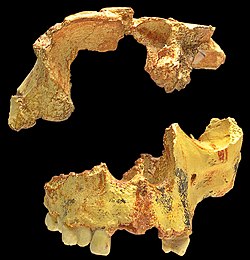 Homo antecessor, incomplete skull found in "Gran Dolina", Atapuerca
 Carnivore skull
 The railroad trench in which the first discoveries were made


