Atractaspis duerdeni
From Wikipedia, the free encyclopedia
| Atractaspis duerdeni | |
|---|---|
 | |
Scientific classification  | |
| Domain: | Eukaryota |
| Kingdom: | Animalia |
| Phylum: | Chordata |
| Class: | Reptilia |
| Order: | Squamata |
| Suborder: | Serpentes |
| Family: | Atractaspididae |
| Genus: | Atractaspis |
| Species: | A. duerdeni |
| Binomial name | |
| Atractaspis duerdeni Gough, 1907 | |
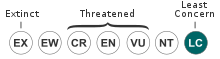
Atractaspis duerdeni, commonly known as the beaked burrowing asp,[2] Duerden's burrowing asp,[3] and Duerden's stiletto snake,[2] is a species of venomous snake in the family Atractaspididae.[4] The species is native to southern Africa.
The specific epithet, duerdeni, is in honor of James Edwin Duerden (1865–1937) of the Albany Museum, Grahamstown, South Africa.[5][6]
Geographic range
A. duerdeni is found in southeastern Botswana, Namibia, and northern South Africa.[2]
Habitat
Description
In his original description Gough described A. duerdeni as being cream-colored above and below, referring to a faded specimen stored in alcohol.[5] In life A. duerdeni is uniformly blackish-brown or gray dorsally, and it is white or creamish-pink ventrally.[3] The dorsal scales are in 21 rows at midbody. The ventrals number 199; the anal is entire; and the subcaudals number 22, all except the first entire. The snout is prominent and subcuneiform. The rostral has a rounded horizontal edge, and the portion visible from above is a little longer than its distance from the frontal.[5] Females may attain a snout-to-vent length (SVL) of 51 cm (20 in), and males, which are smaller, may attain 44 cm (17 in) SVL.[3]
Behavior
Diet
A. duerdeni preys upon sleeping lizards and snakes.[3]
Reproduction
Venom
A venomous species, A. duerdeni can inflict a serious bite requiring medical attention, but no human fatality has been recorded.[3]
_from_Barangay_Nassiping,_Gattaran_-_ZooKeys-266-001-g077.jpg)