August 20 (Eastern Orthodox liturgics)
Eastern Orthodox liturgical calendar day
From Wikipedia, the free encyclopedia
August 19 – Eastern Orthodox liturgical calendar – August 21

All fixed commemorations below are observed on September 2 by Orthodox Churches on the Old Calendar.[note 1]
For August 20, Orthodox Churches on the Old Calendar commemorate the Saints listed on August 7.
Feasts
- Afterfeast of the Dormition.[1][note 2]
Saints
- Prophet Samuel (11th century BC)[1][3][4][note 3][note 4]
- Hieromartyr Philip of Heraclea, Bishop,[6] and with him Martyrs Severus, Memnon,[7] and 37 soldiers,[8] in Philippopolis, Thrace (304)[1][9][10][note 5]
- Saints Reginus and Orestes the Great Martyrs, in Cyprus.[11][12][13]
- Martyr Lucius the Senator, of Cyprus (c. 310)[1][14][15][note 6]
- Martyrs Heliodorus and Dosa (Dausa) in Persia (380)[1][16][17]
- Martyr Photine, at the gates of Blachernae.[9][12][18]
- Saint Hierotheus, first Bishop and Enlightener of Hungary (10th century)[1][9][19][note 7]
- Saint Stephen I of Hungary, King of Hungary (1038)[1][9][20][note 8] (see also: August 16 - West)
Pre-Schism Western saints
- Saint Porphyrius, an early martyr in Palestrina near Rome.[21][note 9]
- Saint Amator (Amadour), hermit.[note 10]
- Saint Maximus, a disciple of St Martin and founder of the monastery of Chinon in France, confessor (c. 470)[5][21]
- Martyr Oswine of Deira, king of Deira (651)[1][9][21][22][note 11]
- Saint Haduin (Harduin), Bishop of Le Mans in France, he founded several monasteries including Notre-Dame-d'Evron (c. 662)[21]
- Saint Philibert of Jumièges (Gaul) (685)[1][5][9][21][note 12]
- Saint Eadberht of Northumbria (Edbert), successor of St Ceolwulf on the throne of Northumbria in England, then became a monastic (768)[21][22][note 13]
- Saint Burchard, monk at Lobbes Abbey in Belgium, then became Bishop of Worms where he was a canonist (1026)[21]
Post-Schism Orthodox saints
- Venerable Abramius of Smolensk, Archimandrite, Wonderworker of Smolensk, (1220)[12][23] (see also: August 21)
- New Martyr Theocharis of Neapolis, Cappadocia (1740)[1][24][note 14]
New martyrs and confessors
- New Hieromartyr Vladimir Chetverin, Priest (1938)[9]
- New Martyrs of Estonia (1944-1955):[25][26][27][note 15]
- New Hieromartyr Peeter (Pähkel), Bishop of Tartu and Pechory (1948)[note 16]
- New Hieromartyr Alypy (Ivlev), Archimandrite (1950)
- New Hieromartyr Vladimir Irodionov, Protopresbyter (1945)[28]
- New Hieromartyr Ioann Vark, Priest (1952)[note 17]
- New Hieromartyr Leonid Lavrov, Priest (1954)
- New Hieromartyr Seraphim Ulyanov, Priest (1955)
- Martyr Alexander Gadalin, church warden (1951)
- Martyr Andrei Punsun (1955)
Other commemorations
- Repose of Hieromonk Seraphim Rose of Platina, California (1982)[1][29]
- Repose of Archimandrite Spyridon (Lukich) of Kyiv (1991)[1]
Icon gallery

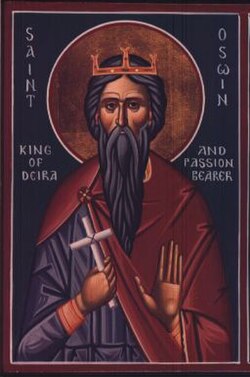 Martyr Oswine of Deira, King of Deira and Passion Bearer.
 St. Stephen I of Hungary, King of Hungary.
 Venerable Abramius of Smolensk.
 New Martyr Theocharis of Neapolis, Cappadocia.
 New Hieromartyr Peeter (Pähkel), Bishop of Tartu and Pechory.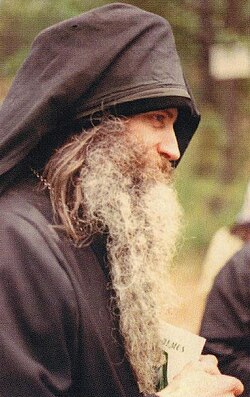


Notes
- The notation Old Style or (OS) is sometimes used to indicate a date in the Julian Calendar (which is used by churches on the "Old Calendar").
The notation New Style or (NS), indicates a date in the Revised Julian calendar (which is used by churches on the "New Calendar"). - "In Thrace, in the time of the governor Apellian, thirty-seven holy martyrs, who had their hands and feet cut off for the faith of Christ, and were cast into a burning furnace. Also, the holy martyrs Severus, and the centurion Memnon, who, suffering the same kind of death, went victoriously to heaven."[5]
- "The same day, St. Lucius, senator, who was converted to the faith, on seeing the constancy of Theodore, bishop of Gyrene, during his martyrdom. He also converted the governor Dignian, with whom he set out for Cyprus, where, seeing other Christians crowned for the confession of the Lord, he offered himself voluntarily, and merited the same crown of martyrdom, by having his head struck off."[5]
- He was officially glorified by the Ecumenical Patriarchate of Constantinople in the year 2000.[19]
- He was officially glorified by the Ecumenical Patriarchate of Constantinople in the year 2000.[20]
- The incorrupt body of a hermit was found buried beneath the church of Our Lady at Rocamadour in France and given this name.
- A prince of Deira, part of the kingdom of Northumbria in England, in 642 he succeeded St Oswald as ruler of Deira, but reigned only nine years, being killed at Gilling in Yorkshire by order of his cousin Oswy. Ever since he has been venerated as a martyr.
- Born in Gascony in France, at the age of twenty he became a monk and then Abbot of Rébais. Later he founded and was Abbot of Jumièges. He opposed the tyrant Ebroin and was imprisoned and exiled. Before his repose he also founded the monastery of Noirmoutier, restored Quinçay and helped several others.
- The successor of St Ceolwulf on the throne of Northumbria in England. After a prosperous reign of twenty years he resigned and went to the monastery of York, where he spent a further ten years in prayer and seclusion.
- In 1923 his relics were translated to Thessaloniki and were placed in the Church of Saint Catherine, Thessaloniki.[24]
- See: (in Russian) Петр (Пяхкель). Википедии. (Russian Wikipedia).
- See: (in Estonian) Johannes Värk. Vikipeediasse. (Estonian Wikipedia).