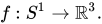
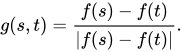
Average crossing number
From Wikipedia, the free encyclopedia
In the mathematical subject of knot theory, the average crossing number of a knot is the result of averaging over all directions the number of crossings in a knot diagram of the knot obtained by projection onto the plane orthogonal to the direction. The average crossing number is often seen in the context of physical knot theory.
More precisely, if K is a smooth knot, then for almost every unit vector v giving the direction, orthogonal projection onto the plane perpendicular to v gives a knot diagram, and we can compute the crossing number, denoted n(v). The average crossing number is then defined as the integral over the unit sphere:[1]
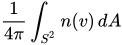
where dA is the area form on the 2-sphere. The integral makes sense because the set of directions where projection doesn't give a knot diagram is a set of measure zero and n(v) is locally constant when defined.