Axiality (geometry)
From Wikipedia, the free encyclopedia
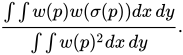
In the geometry of the Euclidean plane, axiality is a measure of how much axial symmetry a shape has. It is defined as the ratio of areas of the largest axially symmetric subset of the shape to the whole shape. Equivalently it is the largest fraction of the area of the shape that can be covered by a mirror reflection of the shape (with any orientation).
A shape that is itself axially symmetric, such as an isosceles triangle, will have an axiality of exactly one, whereas an asymmetric shape, such as a scalene triangle, will have axiality less than one.
Lassak (2002) showed that every convex set has axiality at least 2/3.[1] This result improved a previous lower bound of 5/8 by Krakowski (1963).[2] The best upper bound known is given by a particular convex quadrilateral, found through a computer search, whose axiality is less than 0.816.[3]
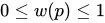
For triangles and for centrally symmetric convex bodies, the axiality is always somewhat higher: every triangle, and every centrally symmetric convex body, has axiality at least . In the set of obtuse triangles whose vertices have -coordinates , , and , the axiality approaches in the limit as the -coordinates approach zero, showing that the lower bound is as large as possible. It is also possible to construct a sequence of centrally symmetric parallelograms whose axiality has the same limit, again showing that the lower bound is tight.[4][5]