Bacillaria
From Wikipedia, the free encyclopedia
| Bacillaria | |
|---|---|
 | |
| Bacillaria paxillifer | |
Scientific classification  | |
| Domain: | Eukaryota |
| Clade: | Diaphoretickes |
| Clade: | SAR |
| Clade: | Stramenopiles |
| Phylum: | Gyrista |
| Subphylum: | Ochrophytina |
| Class: | Bacillariophyceae |
| Order: | Bacillariales |
| Family: | Bacillariaceae |
| Genus: | Bacillaria J.F. Gmelin (1791) |
Bacillaria is a diatom genus in the family Bacillariaceae.[1][2][3]
| External videos | |
|---|---|
 Bacillaria: Distractingly Beautiful Crystal Colonies – Journey to the Microcosmos: Bacillaria: Distractingly Beautiful Crystal Colonies – Journey to the Microcosmos: |
- Bacillaria paradoxa Gmelin 1788
- Bacillaria paxillifer (O.F. Müller) Hendey (1951)
Lifecycle
This genus is photosynthetic, and reproduces sexually and asexually.
Description
Cells are elongated and motile, sliding along each other, in stacked colonies. Cells are rectangular in girdle view (when in colonies), and lanceolate in valve view. Raphe system is slightly keeled and runs from pole to pole. Two large plate-like chloroplasts are present, one near each end of the cell. The nucleus is located centrally. Cells are yellow-brown in colour. Fibulae are strong, and the valve surface is covered in transverse parallel structures called striae.
- Video of several diatoms of the genus Bacillaria moving, in real time
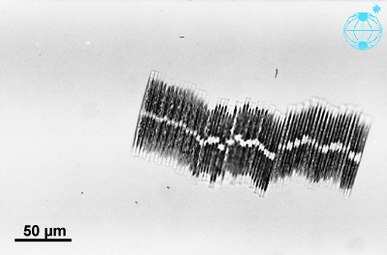 Bacillaria paxillifer
Space station
Three diatom species were sent to the International Space Station, together with the huge (6 mm length) diatoms of Antarctica and the exclusive colonial diatom, Bacillaria paradoxa. The cells of Bacillaria moved next to each other in partial but opposite synchrony by a microfluidics method.[4]
