
Bandy (carriage)
Cart style in India
From Wikipedia, the free encyclopedia
A bandy (sometimes spelled bandi, bamdi or vandi) is a cart used in India and Sri Lanka. It is constructed as a platform between two wheels, without any springs or suspension. It is usually yoked to a pair of oxen, though occasionally just one, or harnessed to small horses. The name is derived from Tamil: vandi and Telugu: bandi, meaning cart. The word continues to be used for almost any simple conveyance in India pulled by a draft animal, including those constructed with rubber automotive tires and those having sides or canopies. The driver, a bandyman, usually sits at the front of the cart straddling the yoke pole.[1][2][3]
In May 1809, the ship HMS Fox brought into Madras her prize, Caravan, which was carrying "...carriages and bandis."[4]
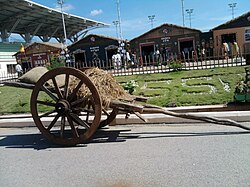 Basic bandy
 Arranged to contain a load
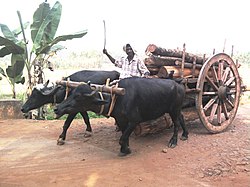 A bandy heavily loaded with timber
 Closeup of yoking style; note also the rough-hewn solid disc wheels
 A modern bandy; note the bandyman is sitting on the yoke pole


.jpg)