Bangdiwala's B
From Wikipedia, the free encyclopedia
Bangdiwala's B statistic was created by Shrikant Bangdiwala in 1985 and is a measure of inter-rater agreement.[1][2] While not as commonly used as the kappa statistic the B test has been used by various workers.[3][4][5][6] While it is principally used as a graphical aid to inter observer agreement, its asymptotic distribution is known.
The test is applicable to testing the agreement between two observers. It is defined to be
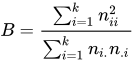
where 


In large samples B has a normal distribution whose variance has a complicated expression.[7] For small samples a permutation test is indicated.[7]
Guidance on its use and its extension to n x n tables have been provided by Munoz & Bangdiwala.[8] It may be more useful than the more commonly used Cohen's kappa in some circumstances.[9]
Tutorials and examples
See also
References
- ↑ Bangwidala S (1985) A graphical test for observer agreement. Proc 45th Int Stats Institute Meeting, Amsterdam, 1, 307–308
- ↑ Bangdiwala K (1987) Using SAS software graphical procedures for the observer agreement chart. Proc SAS User's Group International Conference, 12, 1083-1088
- ↑ Grill E, Mansmann U, Cieza A, Stucki G (2007) Assessing observer agreement when describing and classifying functioning with the International Classification of Functioning, Disability and Health. J Rehabil Med 39(1):71-76
- ↑ Ossa XM, Munoz S, Amigo H, Bangdiwala SI (2010) Secular trend in age at menarche in indigenous and nonindigenous women in Chile. Am J Hum Biol 22(5):688-694
- ↑ Jenkins V, Solis-Trapala I, Langridge C, Catt S, Talbot DC, Fallowfield LJ (2011) What oncologists believe they said and what patients believe they heard: an analysis of phase I trial discussions. J Clin Oncol 29(1):61-68 doi:10.1200/JCO.2010.30.0814
- ↑ Bangdiwala SI, Haedo, AS, Natal, ML, Villaveces A (2008) The Agreement Chart as an Alternative to the Receiver-Operating Characteristic Curve for Diagnostic Tests. J Clin Epidemiol 61, 866–874
- 1 2 Bangdiwala, Shrikant I. (1988) "The Agreement Chart". Department of Biostatistics, University of North Carolina at Chapel Hill, Institute of Statistics Mimeo Series No. 1859 (Appendix)
- ↑ Munoz SR & Bangdiwala SI (1997) Interpretation of Kappa and B statistics measures of agreement. J Applied Stats 24 (1) 105-112 doi:10.1080/02664769723918
- ↑ Shankara V & Bangdiwala SI (2008) "Behavior of agreement measures in the presence of zero cells and biased marginal distributions". Journal of Applied Statistics, 35 (4), 445-464 doi:10.1080/02664760701835052
- ↑ Friendly, M (1995) "Bangdiwala's Observer Agreement Chart" Webpage: Categorical Data Analysis with Graphics (Part 3: Plots for two-way frequency tables) http://www.datavis.ca/courses/grcat/grc3.html#H2_62:Bangdiwala's
- ↑ Stokes, M. (2011) "Up To Speed With Categorical Data Analysis". SAS Global Forum 2011, Paper 346-2011
- ↑ "Documentation for package ‘vcd’ version 1.2-13" Archived 2013-08-10 at the Wayback Machine, R package: Visualizing Categorical Data
- ↑ Friendly, M. "Working with categorical data with R and the vcd and vcdExtra packages", CRAN R project website.


