Lehmer mean
From Wikipedia, the free encyclopedia
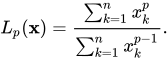
In mathematics, the Lehmer mean of a tuple of positive real numbers, named after Derrick Henry Lehmer,[1] is defined as:

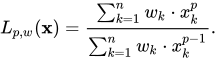
The weighted Lehmer mean with respect to a tuple of positive weights is defined as:

The Lehmer mean is an alternative to power means for interpolating between minimum and maximum via arithmetic mean and harmonic mean.
The derivative of is non-negative

![{\displaystyle {\frac {\partial }{\partial p}}L_{p}(\mathbf {x} )={\frac {\left(\sum _{j=1}^{n}\sum _{k=j+1}^{n}\left[x_{j}-x_{k}\right]\cdot \left[\ln(x_{j})-\ln(x_{k})\right]\cdot \left[x_{j}\cdot x_{k}\right]^{p-1}\right)}{\left(\sum _{k=1}^{n}x_{k}^{p-1}\right)^{2}}},}](https://wikimedia.org/api/rest_v1/media/math/render/svg/54d85f18b17a36f3605fdbded105ff4ba51e8a96)
thus this function is monotonic and the inequality

holds.
The derivative of the weighted Lehmer mean is:

Special cases
- is the minimum of the elements of .
- is the harmonic mean.
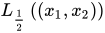
- is the geometric mean of the two values and .
- is the arithmetic mean.
- is the contraharmonic mean.
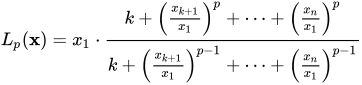
- is the maximum of the elements of . Sketch of a proof: Without loss of generality let be the values which equal the maximum. Then




Applications
Signal processing
Like a power mean, a Lehmer mean serves a non-linear moving average which is shifted towards small signal values for small and emphasizes big signal values for big . Given an efficient implementation of a moving arithmetic mean called smooth you can implement a moving Lehmer mean according to the following Haskell code.

lehmerSmooth :: Floating a => ([a] -> [a]) -> a -> [a] -> [a]
lehmerSmooth smooth p xs =
    zipWith (/)
            (smooth (map (**p) xs))
            (smooth (map (**(p-1)) xs))
- For big it can serve an envelope detector on a rectified signal.
- For small it can serve an baseline detector on a mass spectrum.
Gonzalez and Woods call this a "contraharmonic mean filter" described for varying values of p (however, as above, the contraharmonic mean can refer to the specific case ). Their convention is to substitute p with the order of the filter Q:

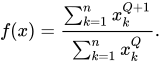
Q=0 is the arithmetic mean. Positive Q can reduce pepper noise and negative Q can reduce salt noise.[2]


