Battle of Bakhmach
World War I battle in Ukraine
From Wikipedia, the free encyclopedia
Battle of Bakhmach (Bitva u Bachmače in Czech), was one of the last battles on the Eastern Front in World War I between the Entente-backed Czechoslovak Legion, Soviet Russia and the Central Powers occupying Ukraine after the Treaty of Brest-Litovsk. The battle lasted from March 8 to March 13, 1918, over the city of Bakhmach and was the last engagement in World War I for the Soviets. Following a Legion victory, the Germans negotiated a truce.

| Battle of Bakhmach | |||||||
|---|---|---|---|---|---|---|---|
| Part of the Eastern Front (World War I) | |||||||
Memorial plaque of Battle of Bakhmach in Olomouc (Czech Republic). Statue of legionar in winter uniform was made by Otakar Španiel. | |||||||
| |||||||
| Belligerents | |||||||
|
Entente Powers:  Soviet Russia Soviet Russia |
Central Powers: Germany Germany | ||||||
| Commanders and leaders | |||||||
 Ludvík Krejčí Nikolai Krylenko Ludvík Krejčí Nikolai Krylenko |
Johannes von Eben | ||||||
| Strength | |||||||
| Parts of the 6th Hanácký Regiment, the 7th Tatranský Regiment and the 4th Prokop Holý Regiment | 224th Infantry Division, 91st Infantry Division | ||||||
| Casualties and losses | |||||||
| 145 killed, 210 wounded, 41 missing | Around 300 killed, hundreds wounded | ||||||
Prelude
On 3 March 1918, Russia, controlled by the Bolsheviks, signed the Treaty of Brest-Litovsk with Germany, in which it gave up control over Ukraine.
On 8 March, German troops reached Bakhmach, an important rail hub, and in doing so threatened the Czechoslovak Legion with encirclement. The threat was especially grave since captured legionnaires were summarily executed as traitors of Austria-Hungary because at the time Czechoslovakia was part of Austria. The 6th "Hanácký" and 7th "Tatranský" Rifle Regiments, together with the Assault battalion of Czechoslovak Army Corps of the Legion, set up defenses at the town against incoming German 91st and 224th Infantry Divisions.
Battle
The battle was notable because the troops were not only fighting for the Bakhmach railway junction (victory of Stanislav Čeček), but also for the bridge over the river Desna, which led to bloody battles at Doch. The climax of the fighting occurred on March 10. Thanks to the Legion victory, the Germans negotiated a truce, during which Czechoslovak armoured trains could freely pass through Bakhmach railway junction to Chelyabinsk.
The Czechoslovak Legion (about 42,000 soldiers) during the truce set up for escape from Russia via the Trans-Siberian Railway. The armies of Germany and Austria-Hungary then started to occupy the land without much resistance.
The Bolsheviks considered the German action at Bakhmach a violation of the terms of the Treaty of Brest-Litovsk and stood by the side of the Czechoslovak people at Bakhmach against the Germans, but it was of no significant help.[1]
Losses of the Legion were: 145 killed, 210 wounded, 41 missing. Estimate of German losses is around 300 dead and hundreds wounded.
Similarly to the Battle of Zborov or the "Siberian anabasis", the battle of Bakhmach became one of the symbols of the Czechoslovak Legions and their fight for independence.
Gallery
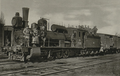 Military intelligence of the 6th Regiment "Hanácký" heading to Bakhmach, March 1918
 Decoration of the train of the 6th Regiment "Hanácký" of the Czechoslovak legions
 Prof. Prokop Maxa speaks at the funeral of the fallen soldiers following the battle
 Memorial plaque to the memory of fallen Czechoslovaks located on Bakhmach railway station
.png)
.png)
.png)
