Bhaktapur District
District in Nepal
From Wikipedia, the free encyclopedia
Bhaktapur District (Nepali: भक्तपुर जिल्ला ⓘ; Nepal Bhasa: ख्वप देश (जिल्ला)) located in the eastern part of Kathmandu valley, is the smallest among seventy-seven districts of Nepal. It is part of Bagmati Province. Bhaktapur District Post Office is 44800. The district, with Bhaktapur as its district headquarters, covers an area of 119 km2 (46 sq mi) and in 2011 had a population of 304,651[3] of whom 9,701 people were absent (mostly working abroad).[4]

Bhaktapur District | |
|---|---|
Kathmandu Valley, Bhaktapur District | |
| Nickname: Khwopa | |
 Location in Bagmati Province | |
| Coordinates: 27.672222°N 85.427778°E | |
| Country | Nepal |
| Province | Bagmati Province |
| Headquarters | Bhaktapur |
| Area | |
• Total | 119 km2 (46 sq mi) |
| Population | |
• Total | 304,651 |
| • Density | 2,560/km2 (6,630/sq mi) |
| 2001 pop.: 225,461 1991 pop.: 172,952 1981 pop.: 159,767 | |
| Time zone | UTC+5:45 (NPT) |
| Area code | +977-1 |
Education
The average literacy rate of Bhaktapur is 81.68% (male 90.48%, female 72.65%), which is growing with educational awareness.[5]
Geography and climate
| Climate Zone[6] | Elevation Range | % of Area |
|---|---|---|
| Subtropical | 1,000 to 2,000 meters 3,300 to 6,600 ft. |
99.4% |
| Temperate | 2,000 to 3,000 meters 6,400 to 9,800 ft. |
0.6% |
Demographics
| Census year | Pop. | ±% p.a. |
|---|---|---|
| 1981 | 159,767 | — |
| 1991 | 172,952 | +0.80% |
| 2001 | 225,461 | +2.69% |
| 2011 | 304,651 | +3.06% |
| 2021 | 430,408 | +3.52% |
 | ||
| Source: Citypopulation[7] | ||
At the time of the 2021 Nepal census, Bhaktapur District had a population of 432,132. 6.48% of the population is under 5 years of age. It has a literacy rate of 87.96% and a sex ratio of 978 females per 1000 males. The entire population lived in municipalities.[8]
Ethnicity wise: Khas are the largest group, making up 43% of the population. Newars are the largest single group, making up 36% of the population. Hill Janjatis, mainly Tamang and Magar, make up 18% of the population.[9]
At the time of the 2021 census, 50.55% of the population spoke Nepali, 32.72% Nepal Bhasha, 9.53% Tamang, 1.51% Maithili and 1.44% Magar as their first language.[10] In 2011, 45.9% of the population spoke Nepali as their first language.[11]
Municipalities
The district is divided into four municipalities:
Places of interest
Gallery
 Bhairavnath Temple, Bhaktapur Durbar Square
 Taumadhi Square, Bhaktapur Durbar Square
 Dattatreya Temple, Bhaktapur Durbar Square
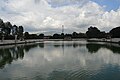 Siddha Pokhari
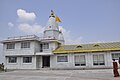 Pilot Baba Ashram, Gunduriya


,_built_during_the_reign_of_King_Yakshya_Malla_in_the_early_15th_century,_Bhaktapur.jpg)
