Biconditional introduction
From Wikipedia, the free encyclopedia


| Type | Rule of inference |
|---|---|
| Field | Propositional calculus |
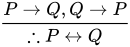
| Statement | If is true, and if is true, then one may infer that is true. |
| Symbolic statement |
In propositional logic, biconditional introduction[1][2][3] is a valid rule of inference. It allows for one to infer a biconditional from two conditional statements. The rule makes it possible to introduce a biconditional statement into a logical proof. If is true, and if is true, then one may infer that is true. For example, from the statements "if I'm breathing, then I'm alive" and "if I'm alive, then I'm breathing", it can be inferred that "I'm breathing if and only if I'm alive". Biconditional introduction is the converse of biconditional elimination. The rule can be stated formally as:
where the rule is that wherever instances of "" and "" appear on lines of a proof, "" can validly be placed on a subsequent line.




