Big-line-big-clique conjecture
From Wikipedia, the free encyclopedia

The big-line-big-clique conjecture is an unsolved problem in discrete geometry, stating that finite sets of many points in the Euclidean plane either have many collinear points, or they have many points that are all mutually visible to each other (no third point blocks any two of them from seeing each other).
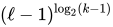
More precisely, the big-line big-clique conjecture states that, for any positive integers and there should exist another number , such that every set of points contains collinear points (a "big line"), mutually visible points (a "big clique"), or both.[1][2]


The big-line-big-clique conjecture was posed by Jan Kára, Attila Pór, and David R. Wood in a 2005 publication.[1][2] It has led to much additional research on point-to-point visibility in point sets.[3]