Bixi (clothing)
Traditional Chinese knee covering
From Wikipedia, the free encyclopedia
Bixi (Chinese: 蔽膝; pinyin: bìxī; lit. 'Cover knee'; Korean: 폐슬; Hanja: 蔽膝; RR: Pyeseul), also known as fu (Chinese: 韍; lit. 'kneepad'),[1] is generic term which refers to a type of traditional Chinese decorative piece of fabric, which acts as a knee covering, in Hanfu.[2] The bixi originated in China where it originated from the primitive clothing of the ancient; since then, it continued to be worn by both men and women,[3] and eventually became part of the Chinese ceremonial attire.[2] The bixi was later introduced in Korea during Goryeo and Joseon by the Ming dynasty, along with many garments for royalties.[4][5]

| Bixi | |||||||
|---|---|---|---|---|---|---|---|
Illustration of a bixi found in the Chinese encyclopedia Gujin Tushu Jicheng, section "Ceremonial Usages", between 1700 and 1725 AD. | |||||||
| Chinese name | |||||||
| Chinese | 蔽膝 | ||||||
| Literal meaning | Knee cover | ||||||
| |||||||
| Alternative Chinese name | |||||||
| Chinese | 韍 | ||||||
| Literal meaning | Kneepad | ||||||
| |||||||
| Korean name | |||||||
| Hangul | 폐슬 | ||||||
| Hanja | 蔽膝 | ||||||
| |||||||
History

The bixi originated from primitive clothing back when animal hides were used to replace foreskin and the genitals.[2]
During the Shang dynasty, the basic style of clothing for men and women consisted of yichang and bixi.[6]
Among many other types of female clothing items, the bixi was listed in tomb inventories dating from 361 AD.[7]
In the Ming dynasty, the bixibecame part of the official clothing.[3]
Construction and design
The bixi is a length of fabric which is typically long enough to reach the kneel-level and cover the front legs when attached to the waist of its wearer.[citation needed]
Usage
Male clothing attire
A red bixi was worn as part of the mianfu which was worn by the Chinese emperors.[2]
A crimson bixi was worn as part of the tongtianguanfu.[8][9]
- Bixi in court and ceremonial attire
 Emperor Zhao of Han with a red bixi.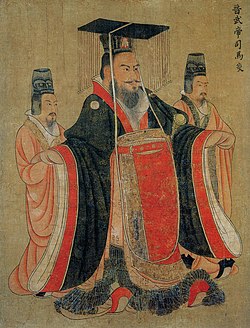

 Emperor Xuanzu of Song wearing tongtianguanfu with a crimson bixi.


.jpg)
Female clothing attire
A bixi was also worn with the diyi worn by Chinese empresses; the bixi worn in the diyi hanged in front of the garment and had the same colour as the bottom colour as the lower skirt.[10]
- Bixi in court and ceremonial attire
 Song dynasty empress wearing diyi with a bixi.


