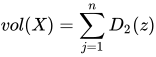
Bloch group
From Wikipedia, the free encyclopedia
In mathematics, the Bloch group is a cohomology group of the Bloch–Suslin complex, named after Spencer Bloch and Andrei Suslin. It is closely related to polylogarithm, hyperbolic geometry and algebraic K-theory.
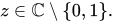
The dilogarithm function is the function defined by the power series
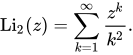
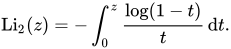
It can be extended by analytic continuation, where the path of integration avoids the cut from 1 to +∞
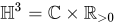
The Bloch–Wigner function is related to dilogarithm function by
- , if

This function enjoys several remarkable properties, e.g.
- is real analytic on




The last equation is a variant of Abel's functional equation for the dilogarithm (Abel 1881).
Definition
Let K be a field and define as the free abelian group generated by symbols [x]. Abel's functional equation implies that D2 vanishes on the subgroup D(K) of Z(K) generated by elements
![{\displaystyle \mathbb {Z} (K)=\mathbb {Z} [K\setminus \{0,1\}]}](https://wikimedia.org/api/rest_v1/media/math/render/svg/0845fd37601e396987d20ff2d45bbef186909f73)
![{\displaystyle [x]+[y]+\left[{\frac {1-x}{1-xy}}\right]+[1-xy]+\left[{\frac {1-y}{1-xy}}\right]}](https://wikimedia.org/api/rest_v1/media/math/render/svg/4f27ce54b6edbe97bf218f8b87dcf21a1dc73017)
Denote by A (K) the quotient of by the subgroup D(K). The Bloch-Suslin complex is defined as the following cochain complex, concentrated in degrees one and two

- , where ,

![{\displaystyle d[x]=x\wedge (1-x)}](https://wikimedia.org/api/rest_v1/media/math/render/svg/491e81b9df4c516b36da592027f769921e20f402)
then the Bloch group was defined by Bloch (Bloch 1978)

The Bloch–Suslin complex can be extended to be an exact sequence

This assertion is due to the Matsumoto theorem on K2 for fields.
Relations between K3 and the Bloch group
If c denotes the element and the field is infinite, Suslin proved (Suslin 1990) the element c does not depend on the choice of x, and
![{\displaystyle [x]+[1-x]\in \operatorname {B} _{2}(K)}](https://wikimedia.org/api/rest_v1/media/math/render/svg/17f8d08b89a040fa8f83999a8b595f8ec5e1400c)

where GM(K) is the subgroup of GL(K), consisting of monomial matrices, and BGM(K)+ is the Quillen's plus-construction. Moreover, let K3M denote the Milnor's K-group, then there exists an exact sequence

where K3(K)ind = coker(K3M(K) → K3(K)) and Tor(K*, K*)~ is the unique nontrivial extension of Tor(K*, K*) by means of Z/2.