Boronia hapalophylla
From Wikipedia, the free encyclopedia
| Shannon Creek boronia | |
|---|---|
.jpg) | |
| Boronia hapalophylla in the Sherwood Nature Reserve near Glenreagh | |
Scientific classification  | |
| Kingdom: | Plantae |
| Clade: | Tracheophytes |
| Clade: | Angiosperms |
| Clade: | Eudicots |
| Clade: | Rosids |
| Order: | Sapindales |
| Family: | Rutaceae |
| Genus: | Boronia |
| Species: | B. hapalophylla |
| Binomial name | |
| Boronia hapalophylla | |
 | |
| Occurrence data from Australasian Virtual Herbarium | |
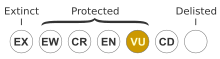

Boronia hapalophylla is a plant in the citrus family Rutaceae and is endemic to New South Wales. It is an erect or straggling shrub with simple leaves, hairy branches and relatively large pink, four-petalled flowers.
Boronia hapalophylla is an erect or straggling shrub that grows to about 3 m (10 ft) high and has branches with minute, star-like hairs. The leaves are simple, narrow elliptic to lance-shaped, mostly 18–50 mm (0.7–2 in) long, 3.5–12 mm (0.1–0.5 in) wide with a hairy, paler underside and the edges rolled down. The leaves are sessile or sometimes have a petiole up to 1.5 mm (0.06 in) long. The flowers are pink, sometimes white and are arranged singly or in groups of up to seven in leaf axils, the groups on a peduncle up to 5 mm (0.2 in) long (if present), the individual flowers on a pedicel 2–6.5 mm (0.08–0.3 in) long. The four sepals are broadly egg-shaped to triangular, mostly 5–10 mm (0.2–0.4 in) long, 3–4.5 mm (0.1–0.2 in) wide and hairy on the back. The four petals are 6–15 mm (0.2–0.6 in) long and densely hairy on the back. Flowering occurs mainly in August and September.[2][3][4][5]
Taxonomy and naming
Boronia hapalophylla was first formally described in 2004 by Marco Duretto, John Edwards and Patricia Edwards who published the description in the journal Telopea.[6][2] The specific epithet (hapalophylla) means "soft to touch", referring to the soft, hairy surface of the leaves.[2]