Boronia quadrilata
From Wikipedia, the free encyclopedia
| Boronia quadrilata | |
|---|---|
Scientific classification  | |
| Kingdom: | Plantae |
| Clade: | Tracheophytes |
| Clade: | Angiosperms |
| Clade: | Eudicots |
| Clade: | Rosids |
| Order: | Sapindales |
| Family: | Rutaceae |
| Genus: | Boronia |
| Species: | B. quadrilata |
| Binomial name | |
| Boronia quadrilata | |
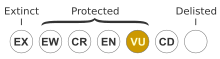
Boronia quadrilata is a species of plant in the citrus family Rutaceae and is endemic to a small area in the Northern Territory, Australia. It is an erect, glabrous shrub with simple, sessile, wedge-shaped leaves, pale yellow petals and green sepals that are longer and wider than the petals. It is only known from a population of about fifteen plants.
Boronia quadrilata is an erect shrub that typically grows to a height of about 1.5 m (5 ft) and has stems that are more or less square in cross-section. The plant is glabrous apart from the petals, which have star-like hairs, especially on their backs. The leaves are simple, sessile and wedge-shaped, 23–55 mm (0.91–2.2 in) long and 12–20 mm (0.5–0.8 in) wide. The flowers are borne on a peduncle 2–4 mm (0.08–0.2 in) long, individual flowers on a pedicel 0.5–3 mm (0.02–0.1 in) long. The sepals are green, triangular, 5.5–6 mm (0.22–0.24 in) long and about 3 mm (0.1 in) wide. The petals are pale yellow, 4–5 mm (0.16–0.20 in) long and about 2 mm (0.08 in) wide. The sepals and petals enlarge as the fruit develops. Flowering has been observed in March, May and August and the fruit is a capsule about 6 mm (0.24 in) and 3.5 mm (0.14 in) wide.[2][3][4]
Taxonomy and naming
Boronia quadrilata was first formally described in 1997 by Marco F. Duretto who published the description in Australian Systematic Botany.[5]