Brahmagupta triangle
From Wikipedia, the free encyclopedia
A Brahmagupta triangle is a triangle whose side lengths are consecutive positive integers and area is a positive integer.[1][2] The triangle whose side lengths are 3, 4, 5 is a Brahmagupta triangle and so also is the triangle whose side lengths are 13, 14, 15. The Brahmagupta triangle is a special case of the Heronian triangle which is a triangle whose side lengths and area are all positive integers but the side lengths need not necessarily be consecutive integers. A Brahmagupta triangle is called as such in honor of the Indian astronomer and mathematician Brahmagupta (c. 598 – c. 668 CE) who gave a list of the first eight such triangles without explaining the method by which he computed that list.[1][3]
A Brahmagupta triangle is also called a Fleenor-Heronian triangle in honor of Charles R. Fleenor who discussed the concept in a paper published in 1996.[4][5][6][7] Some of the other names by which Brahmagupta triangles are known are super-Heronian triangle[8] and almost-equilateral Heronian triangle.[9]
The problem of finding all Brahmagupta triangles is an old problem. A closed form solution of the problem was found by Reinhold Hoppe in 1880.[10]
Let the side lengths of a Brahmagupta triangle be , and where is an integer greater than 1. Using Heron's formula, the area of the triangle can be shown to be


Since has to be an integer, must be even and so it can be taken as where is an integer. Thus,


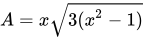
Since has to be an integer, one must have for some integer . Hence, must satisfy the following Diophantine equation:

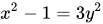

- .
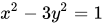
This is an example of the so-called Pell's equation with . The methods for solving the Pell's equation can be applied to find values of the integers and .
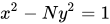


Obviously , is a solution of the equation . Taking this as an initial solution the set of all solutions of the equation can be generated using the following recurrence relations[1]



or by the following relations

They can also be generated using the following property:

The following are the first eight values of and and the corresponding Brahmagupta triangles:
1 2 3 4 5 6 7 8 2 7 26 97 362 1351 5042 18817 1 4 15 56 209 780 2911 10864 Brahmagupta
triangle3,4,5 13,14,15 51,52,53 193,194,195 723,724,725 2701,2702,2703 10083,10084,10085 37633,37634,37635

The sequence is entry A001075 in the Online Encyclopedia of Integer Sequences (OEIS) and the sequence is entry A001353 in OEIS.





