Bramble (graph theory)
From Wikipedia, the free encyclopedia

In graph theory, a bramble for an undirected graph G is a family of connected subgraphs of G that all touch each other: for every pair of disjoint subgraphs, there must exist an edge in G that has one endpoint in each subgraph. The order of a bramble is the smallest size of a hitting set, a set of vertices of G that has a nonempty intersection with each of the subgraphs. Brambles may be used to characterize the treewidth of G.[1]
A haven of order k in a graph G is a function β that maps each set X of fewer than k vertices to a connected component of G − X, in such a way that every two subsets β(X) and β(Y) touch each other. Thus, the set of images of β forms a bramble in G, with order k. Conversely, every bramble may be used to determine a haven: for each set X of size smaller than the order of the bramble, there is a unique connected component β(X) that contains all of the subgraphs in the bramble that are disjoint from X.
Seymour and Thomas proved that the order of a bramble (or equivalently, of a haven) characterizes treewidth: if k is the largest possible order among all brambles of a graph, then the graph has treewidth k − 1.[1] In particular, if k is the order of some bramble, then the treewidth is at least k − 1.
Size of brambles
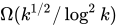
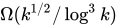
Expander graphs of bounded degree have treewidth proportional to their number of vertices, and therefore also have brambles of linear order. However, as Martin Grohe and Dániel Marx showed, for these graphs, a bramble of such a high order must include exponentially many sets. More strongly, for these graphs, even brambles whose order is slightly larger than the square root of the treewidth must have exponential size. However, Grohe and Marx also showed that every graph of treewidth k has a bramble of polynomial size and of order .[2]