Bremen-class frigate
Frigate ship class
From Wikipedia, the free encyclopedia
The eight F122 Bremen-class frigates of the German Navy was a series of frigates commissioned between 1982 and 1990. The design was based on the proven and robust Dutch Kortenaer class but used a different propulsion system and hangar lay-out. The ships were built for anti-submarine warfare as a primary task although they were not fitted with towed array sonars. They were also equipped for anti-surface warfare, while having anti-aircraft warfare point defences. The Bremen class frigates replaced both the Zerstörer 1 class destroyers and the Köln class frigates.[4][5]

 Karlsruhe on 21 August 2013 | |
| Class overview | |
|---|---|
| Builders | |
| Operators |  German Navy German Navy |
| Preceded by | |
| Succeeded by | Baden-Württemberg class[3] |
| Built | 1979–1990 |
| In commission | 1982–2022 |
| Completed | 8 |
| Retired | 8 |
| General characteristics | |
| Type | Frigate |
| Displacement | 3,680 tonnes (3,620 long tons) |
| Length | 130.50 m (428 ft 2 in) |
| Beam | 14.60 m (47 ft 11 in) |
| Draft | 6.30 m (20 ft 8 in) |
| Installed power |
|
| Propulsion | 2 × propeller shafts, controllable pitch, five-bladed Sulzer-Escher propellers, later replaced with seven-bladed ones from Wegemann & Co. ("Bremen" only) |
| Speed | 30 knots (56 km/h) |
| Range | more than 4,000 nmi (7,400 km) at 18 knots (33 km/h) |
| Complement | 202 crew plus 20 aviation |
| Sensors & processing systems |
|
| Electronic warfare & decoys |
|
| Armament |
|
| Aircraft carried | Place for 2 Sea Lynx Mk.88A helicopters equipped with torpedoes, air-to-surface missiles Sea Skua, and/or heavy machine gun. |
This class of ship was one of the last to be constructed under post-war displacement limitations imposed by the WEU on West Germany.[citation needed]
All eight Bremen-class frigates were replaced by the F125-class frigate. Prior to that the Bremen class served as the backbone of the German Navy.[6]
Employment
During the Cold War period, the ships' main war task was to escort convoys for reinforcement and resupply of allied forces in Europe in the Northern Atlantic. They frequently took part in NATO Standing Naval Forces. Since 1990, all ships have served in additional supporting missions such as the embargo operations against former Yugoslavia in the Adriatic Sea or Operation Enduring Freedom against the international terrorism.
During their lifetime, the ships' equipment has frequently been modernized and proven to be reliable platforms.[citation needed]
Notable actions
Karlsruhe successfully assisted an Egyptian freighter repel pirates on 25 December 2008 in the Gulf of Aden.[citation needed]
In 2012 Rheinland-Pfalz was reportedly used to gather intelligence on Syrian troop movements to be passed to the Free Syrian Army to assist in their attacks on the Syrian Army.[7]
In December 2015 Augsburg joined the French aircraft carrier Charles de Gaulle in the south-eastern Mediterranean Sea to go to the Arabian Sea as part of the intervention against ISIS in the Syrian Civil War.[8][9]
Ships
| Pennant | Name | Builder | Laid down | Launched | Commissioned | Decommissioned | Fate |
|---|---|---|---|---|---|---|---|
| F207 | Bremen | Bremer Vulkan, Bremen | 9 July 1979 | 27 September 1979 | 7 May 1982 | 28 March 2014 | Scrapped, 2021 |
| F208 | Niedersachsen | AG Weser, Bremen | 9 November 1979 | 9 June 1980 | 15 October 1982 | 26 June 2015[10] | Scrapped, 2021-22 |
| F209 | Rheinland-Pfalz | Blohm + Voss, Hamburg | 25 September 1979 | 3 September 1980 | 9 May 1983 | 22 March 2013[11] | Scrapped, 2017 |
| F210 | Emden | Nordseewerke, Emden | 23 June 1979 | 17 December 1980 | 7 October 1983 | 29 November 2013 | Laid up in Wilhelmshaven |
| F211 | Köln | Blohm + Voss, Hamburg | 16 June 1980 | 29 May 1981 | 19 October 1984 | 31 July 2012[12] | Scrapped, 2016-17 |
| F212 | Karlsruhe | Howaldtswerke, Kiel | 10 March 1981 | 8 January 1982 | 19 April 1984 | 16 June 2017 | Laid up in Kiel for blast tests |
| F213 | Augsburg | Bremer Vulkan, Bremen | 4 April 1987 | 17 September 1987 | 3 October 1989 | 30 June 2019 | Laid up in Wilhelmshaven |
| F214 | Lübeck | Nordseewerke, Emden | 1 June 1987 | 15 October 1987 | 19 March 1990 | 15 December 2022[13] | Laid up in Wilhelmshaven |
All ships were based in Wilhelmshaven. Together they formed the 4. Fregattengeschwader (4th Frigate Squadron) of the German Navy.[citation needed]
Gallery
 Bremen
 Niedersachsen at New York, 2004
 Köln
Köln Rheinland-Pfalz
 Lübeck
 Emden at Portsmouth, UK, 2013
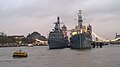 Karlsruhe at London, 2016


