Bromus commutatus
From Wikipedia, the free encyclopedia
| Bromus commutatus | |
|---|---|
 | |
| A panicle of Bromus commutatus Bromus hordeaceus! | |
Scientific classification  | |
| Kingdom: | Plantae |
| Clade: | Tracheophytes |
| Clade: | Angiosperms |
| Clade: | Monocots |
| Clade: | Commelinids |
| Order: | Poales |
| Family: | Poaceae |
| Subfamily: | Pooideae |
| Genus: | Bromus |
| Species: | B. commutatus |
| Binomial name | |
| Bromus commutatus Schrad. | |
| Synonyms[1] | |
| |
Bromus commutatus, the meadow brome,[2] is an annual or biennial[3] species of plant in the grass family Poaceae. In the United States it is known as hairy chess.
The height ranges from 40 to 120 cm (47 in). The panicle is 7–20 cm, usually nodding and often spreading,[4] but erect as first.[5] The leaf-sheaths are hairy, the upper are usually hairless.[5] B. commutatus is stouter than B. racemosus, the smooth brome, with a flower-head not drooping to one side and a broader elongated branched flower head.[6]
Meadow brome structure
 Node structure
 Panicle detail
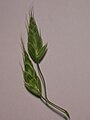 Spikelets detail


Habitat and distribution
It is found in meadows, wasteground, road verges, hayfields and rough grassland.[7] Found throughout the United Kingdom, it is common in England on the moist soils of water meadows; it is rare in Scotland, Ireland and Wales.[3] It is found naturally throughout Europe, N. Africa, W. Asia. It has been introduced into North America and in the United States is known as 'Hairy Chess'. The flowering period is from May to July.[3]
Crop value

The species has no fodder value in the United Kingdom and is regarded as a weed. The attractive inflorescences may be used, either fresh or dry, in flower arrangements.[3]
