Broughton Island (Nunavut)
From Wikipedia, the free encyclopedia
 Qikiqtarjuaq, 24 July 2001 | |
  Broughton Island  Broughton Island | |
| Geography | |
|---|---|
| Location | Coast of the Cumberland Peninsula, Baffin Island |
| Coordinates | 67°34′N 063°54′W / 67.567°N 63.900°W[1] |
| Archipelago | Arctic Archipelago |
| Area | 127.6[3] km2 (49.3 sq mi) |
| Administration | |
Canada | |
| Territory | Nunavut |
| Region | Qikiqtaaluk |
| Largest settlement | Qikiqtarjuaq (pop. 593) |
| Demographics | |
| Population | 593 (2021[4]) |
| Ethnic groups | Inuit |
Broughton Island is a 127.6 km2 (49.3 sq mi)[3] island in the Arctic Archipelago.
It is located above the Arctic Circle in the Davis Strait, off Baffin Island about 2 km (1.2 mi) west of the Cumberland Peninsula. To the east Baffin Bay, and the Baffin Mountains are located to the west, more specifically the Arctic Cordillera mountain range.
Demographics
The only community on the island is Qikiqtarjuaq with a population of 593.[4] It is one of only eleven islands, out of more than 36,000, in the Arctic Archipelago that are inhabited. The Inuit residents of Qikiqtarjuaq moved there in 1963 from a whaling station at Kivitoo about 50 km (31 mi) north.
Qikiqtarjuaq hosts an annual "Suicide Prevention Walk".[5] Local participants would walk a total distance of 60 km (37 mi) across the tundra from Kivitoo'[6] Today the walk is much shorter than the original two and a half days, but it is still meant to promote hope among the community.
The island was the home of FOX-5, a Distant Early Warning Line and now a North Warning System site.
There is also an access road that was built to Tisunaaq, also known as Ceetee Land to the Elders, and another road is in construction to Qikiqtarjuaqruluk, or Old Broughton, an abandoned settlement.
Wildlife
The island is known for Arctic wildlife including ring seals, polar bears, bowhead whales, narwhals, and bird watching. The Qaqulluit National Wildlife Area is located about 55 km (34 mi) south east at 67°14′N 62°28′W / 67.233°N 62.467°W.[7] It serves as the northern access point for Auyuittuq National Park (see also Pangnirtung) and is approximately 2 hours by boat in the summer months, 2 - 2.5 hours by vehicle or snowmobile in winter months. All park visitors must register and book an orientation session prior to entry into the park, and non-Inuit who visit Auyuittuq must do so by hiring a local licensed operator.
Gallery
 Some of the views around Qikiqtarjuaq (12 July 2011)
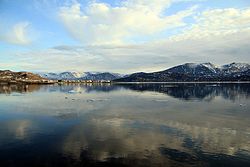 Summer in the Arctic at Broughton Island (12 July 2011)
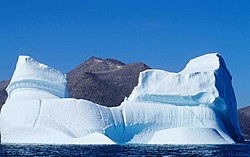 Iceberg near Qikiqtarjuaq (Davis Strait, 12 August 2000)


