Brownian bridge
Stochastic process in physics
From Wikipedia, the free encyclopedia
A Brownian bridge is a continuous-time gaussian process B(t) whose probability distribution is the conditional probability distribution of a standard Wiener process W(t) (a mathematical model of Brownian motion) subject to the condition (when standardized) that W(T) = 0, so that the process is pinned to the same value at both t = 0 and t = T. More precisely:
![{\displaystyle B_{t}:=(W_{t}\mid W_{T}=0),\;t\in [0,T]}](http://wikimedia.org/api/rest_v1/media/math/render/svg/298ba09ed98e6338883098882f8373ea4900d23d)

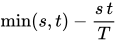
The expected value of the bridge at any in the interval is zero, with variance , implying that the most uncertainty is in the middle of the bridge, with zero uncertainty at the nodes. The covariance of B(s) and B(t) is , or if . The increments in a Brownian bridge are not independent.

![{\displaystyle [0,T]}](http://wikimedia.org/api/rest_v1/media/math/render/svg/35ccef2d3dc751e081375d51c111709d8a1d7ac6)



Relation to other stochastic processes
If is a standard Wiener process (i.e., for , is normally distributed with expected value and variance , and the increments are stationary and independent), then


is a Brownian bridge for . It is independent of [1]
![{\textstyle t\in [0,T]}](http://wikimedia.org/api/rest_v1/media/math/render/svg/c9f323e9c3a40684a705f24de7aefe0049671842)

Conversely, if is a Brownian bridge for and is a standard normal random variable independent of , then the process

![{\textstyle t\in [0,1]}](http://wikimedia.org/api/rest_v1/media/math/render/svg/28ade07f7bfe79a6af8441146cd24da8dacd8641)


is a Wiener process for . More generally, a Wiener process for can be decomposed into

Another representation of the Brownian bridge based on the Brownian motion is, for

Conversely, for
![{\textstyle t\in [0,\infty ]}](http://wikimedia.org/api/rest_v1/media/math/render/svg/e09b5a5acafab894679729da3abb00eb7c0cb0c1)

The Brownian bridge may also be represented as a Fourier series with stochastic coefficients, as

where are independent identically distributed standard normal random variables (see the Karhunen–Loève theorem).

A Brownian bridge is the result of Donsker's theorem in the area of empirical processes. It is also used in the Kolmogorov–Smirnov test in the area of statistical inference.
Let , for a Brownian bridge with ; then the cumulative distribution function of is given by[2]
![{\displaystyle K=\sup _{t\in [0,1]}|B(t)|}](http://wikimedia.org/api/rest_v1/media/math/render/svg/1ab27545201bcf6b446b42c5ee0da6d2dbdb1b44)


Decomposition by zero-crossings
The Brownian bridge can be "split" by finding the last zero before the midpoint, and the first zero after, forming a (scaled) bridge over , an excursion over , and another bridge over . The joint pdf of is given by


![{\displaystyle [0,\tau _{-}]}](http://wikimedia.org/api/rest_v1/media/math/render/svg/e6e4fec343c0bf7711e5c85485752cc616923483)
![{\displaystyle [\tau _{-},\tau _{+}]}](http://wikimedia.org/api/rest_v1/media/math/render/svg/30cf8b04c411782a1bbd9fde4b026b118979cb83)
![{\displaystyle [\tau _{+},1]}](http://wikimedia.org/api/rest_v1/media/math/render/svg/1128290cebb07aeb0e280088bc71aa19922d486b)


which can be conditionally sampled as


where are uniformly distributed random variables over (0,1).

Intuitive remarks
A standard Wiener process satisfies W(0) = 0 and is therefore "tied down" to the origin, but other points are not restricted. In a Brownian bridge process on the other hand, not only is B(0) = 0 but we also require that B(T) = 0, that is the process is "tied down" at t = T as well. Just as a literal bridge is supported by pylons at both ends, a Brownian Bridge is required to satisfy conditions at both ends of the interval [0,T]. (In a slight generalization, one sometimes requires B(t1) = a and B(t2) = b where t1, t2, a and b are known constants.)
Suppose we have generated a number of points W(0), W(1), W(2), W(3), etc. of a Wiener process path by computer simulation. It is now desired to fill in additional points in the interval [0,T], that is to interpolate between the already generated points. The solution is to use a collection of T Brownian bridges, the first of which is required to go through the values W(0) and W(1), the second through W(1) and W(2) and so on until the Tth goes through W(T-1) and W(T).
General case
For the general case when W(t1) = a and W(t2) = b, the distribution of B at time t ∈ (t1, t2) is normal, with mean

and variance

and the covariance between B(s) and B(t), with s < t is
