The blue ring is formed by the difference in area between a larger circle with radius c and a smaller circle with radius b.
Let the green circle have radius a. Then the condition for the equality of the two areas is:
 , i.e.,
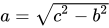 .
.
For the special case  (Figure 4), the condition for the equality of the two areas is:
 , i.e.,
 .
.
In this case, the larger circle is completely decomposed into the smaller green circle and the blue ring of equal area.[1][2]

 Figure 1
 Figure 2
 Figure 3
 Figure 4


