COCONUTS-2b
Gas giant exoplanet orbiting L 34-26
From Wikipedia, the free encyclopedia
COCONUTS-2 b is a gas giant exoplanet that orbits the M-type star L 34-26. With a mass of 8 Jupiters,[6] it takes over one million years to complete one orbit around the star orbiting 7,500 AU away from it.[1]

Michael Liu
Zach Claytor
William Best
Trent Dupuy
Robert Siverd[1]
COCONUTS-2b with unWISE. The planet in the center of the image stands out due to its red color. The host star is not pictured here. | |
| Discovery | |
|---|---|
| Discovered by | Zhoujian Zhang Michael Liu Zach Claytor William Best Trent Dupuy Robert Siverd[1] |
| Discovery date | August 2011 (as a free-floating brown dwarf)[2]
|
| Direct imaging | |
| Designations | |
| WISEPA J075108.79-763449.6[2] | |
| Orbital characteristics | |
| 7,500+5,200 −2,100 AU[4] (1.1×10¹² km) | |
| 1.1+1.3 −0.4×10⁶[4] years | |
| Star | L 34-26 |
| Physical characteristics | |
| 1.03+0.01 −0.02 RJ[5] | |
| Mass | 7.3±0.3 MJ[5] |
| log(g) = 4.30+0.04 −0.02 cgs[5] | |
| Temperature | 496+5 −3 K[5] |
Spectral type | T9.5±0.5[6] |
The planet was discovered in 2011 and was initially identified as a T9 free-floating brown dwarf WISEPA J075108.79−763449.6.[2] During the COol Companions ON Ultrawide orbiTS (COCONUTS) survey, its association with L 34-26 was announced in 2021.[7] At a distance of 35.5 light-years (10.9 parsecs), COCONUTS-2b was the closest directly imaged exoplanet to Earth until Epsilon Indi Ab was imaged in 2024.[8]
Proposed formation scenarios
The researchers found that it is unlikely that COCONUTS-2b was formed inside the protoplanetary disk of the host star and may instead have formed separately.[4][9]
The peculiar properties of COCONUTS-2b could be explained with different scenarios as proposed by Marocco et al. in 2024. The properties could be explained by a non-solar carbon-to-oxygen ratio, meaning that it formed inside a disk around L 34–26. In this scenario the most likely way COCONUTS-2b got in a higher orbit is by a stellar fly-by of two binaries or two planetary systems. In the second scenario L 34-26 is not actually young, but mimics youth due to tidal and/or magnetic interactions with an unseen companion. In this scenario COCONUTS-2b would be an old brown dwarf. In a third scenario COCONUTS-2b could be a captured old brown dwarf. This is however seen as unlikely due to the stellar fly-by requiring a low velocity.[10]
Another study in 2024 found that the metallicity of the planet is lower than that of the host star, which is inconsistent with it forming on its current location, like a binary system. Only their third-preferred model is consistent with a binary-like formation, because in this model the metallicity of host star and planet agreed.[6]
Atmosphere
The planet's spectral type suggests high amounts of methane, water vapor and low amounts of carbon monoxide in the atmosphere of COCONUTS-2b. It might also have both clouds and a non-equilibrium process in its atmosphere.[2][4]
Due to its large orbital separation, COCONUTS-2b is a great laboratory to study the atmosphere and composition of young gas-giant exoplanets.[3] The planet's temperature is estimated at 496 K (223 °C; 433 °F).[5]
Observations with Gemini/Flamingos-2 showed a spectral type of T9.5±0.5, near the T/Y transition. The spectrum is also more consistent with disequilibrium chemistry and the presence of clouds. Additionally the atmosphere shows a diabatic thermal structure, meaning the pressure-temperature profile is non-adiabatic. Adiabatic means here an increase of the temperature with pressure. The observation also indicate a sub- or near-solar metallicity.[6]
Host star
| Observation data Epoch J2000.0 Equinox J2000.0 | |
|---|---|
| Constellation | Chamaeleon |
| Right ascension | 07h 49m 12.678s[11] |
| Declination | −76° 42′ 06.72″[11] |
| Apparent magnitude (V) | 11.3[12] |
| Characteristics | |
| Evolutionary stage | Red dwarf |
| Spectral type | M3V[12] |
| Astrometry | |
| Radial velocity (Rv) | 1.19±0.61[13] km/s |
| Proper motion (μ) | RA: −102.154 mas/yr[11] Dec.: −192.918 mas/yr[11] |
| Parallax (π) | 91.8263±0.0185 mas[11] |
| Distance | 35.519 ± 0.007 ly (10.890 ± 0.002 pc) |
| Details | |
| Mass | 0.40+0.01 −0.02[14] M☉ |
| Radius | 0.366+0.015 −0.014[14] R☉ |
| Surface gravity (log g) | 4.91+0.02 −0.01[14] cgs |
| Temperature | 3,552+65 −32[14] K |
| Age | 414±23[14] Myr |
| Other designations | |
| L 34-26, COCONUTS-2A, WISEPA J075108.79-763449.6, 1RXS J074912.9-764202, 2MASS J07491271-7642065, NLTT 18592, TIC 272232401, TYC 9381-1809-1, UCAC4 067-006518 | |
| Database references | |
| SIMBAD | data |

L 34–26, also known as COCONUTS-2A and TYC 9381–1809–1, is a M3-type dwarf star located 35 light-years from Earth, in the constellation of Chamaeleon. The star is about one-third the mass of the Sun, with an age between 150 and 800 million years old.[15]
Researchers using TESS found that L 34-26 showed stellar flares about every 0.48 days. It was the most active planet hosting star in their sample. The team studying the host star also found that L 34-26 is fast rotating with a rotation period of 2.83 days. The planet should not be influenced by the flares, because of the large orbital separation.[16] The star is seen almost equator-on with i = 81.8°±5.8°[10] and is considered to be a member of the Ursa Major corona with a probability of 99%. Being a member of the corona, the age of the star and its planet would be 414±23 million years.[14]
Gallery
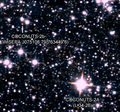 The COCONUTS-2 system with unWISE
 The planet COCONUTS-2b with Gemini-South
 Allwise image by the discoverers, showing planet COCONUTS-2b

