Canada men's national ice hockey team
Men's national ice hockey team representing Canada
From Wikipedia, the free encyclopedia
The Canada men's national ice hockey team (popularly known as Team Canada; French: Équipe Canada) is the ice hockey team representing Canada internationally. The team is overseen by Hockey Canada, a member of the International Ice Hockey Federation. From 1920 until 1963, Canada's international representation was by senior amateur club teams. Canada's national men's team was founded in 1963 by David Bauer as a part of the Canadian Amateur Hockey Association, playing out of the University of British Columbia.[4] The nickname "Team Canada" was first used for the 1972 Summit Series and has been frequently used to refer to both the Canadian national men's and women's teams ever since.
.svg)
| |
| Nickname |
|
|---|---|
| Association | Hockey Canada |
| General manager | Doug Armstrong |
| Head coach | Jon Cooper |
| Assistants |
|
| Captain | Sidney Crosby |
| Most games | Brad Schlegel (304) |
| Top scorer | Brad Schlegel |
| Most points | Cliff Ronning (156) |
| Team colours | Red, black, white[1] |
| IIHF code | CAN |
.png) | |
| Ranking | |
| Current IIHF | 3 ( 3) (26 May 2025)[2] 3) (26 May 2025)[2] |
| Highest IIHF | 1 (2003–2005, 2008, 2010, 2015–2021, 2023–2025) |
| Lowest IIHF | 5 (2012–13) |
| First international | |
Canada  8–1 8–1  Switzerland Switzerland(Les Avants, Switzerland; January 10, 1910) | |
| Biggest win | |
Canada  47–0 47–0  Denmark Denmark(Stockholm, Sweden; February 12, 1949) | |
| Biggest defeat | |
Soviet Union  11–1 11–1  Canada Canada(Vienna, Austria; April 24, 1977) | |
| Olympics | |
| Appearances | 24 (first in 1920) |
| Medals |  Gold: 9 (1920, 1924, 1928, 1932, 1948, 1952, 2002, 2010, 2014) Gold: 9 (1920, 1924, 1928, 1932, 1948, 1952, 2002, 2010, 2014) Silver: 5 (1936, 1960, 1992, 1994, 2026) Silver: 5 (1936, 1960, 1992, 1994, 2026) Bronze: 3 (1956, 1968, 2018) Bronze: 3 (1956, 1968, 2018) |
| IIHF World Championships | |
| Appearances | 78 (first in 1920) |
| Best result |  Gold: 28 (1920, 1924, 1928, 1930, 1931, 1932, 1934, 1935, 1937, 1938, 1939, 1948, 1950, 1951, 1952, 1955, 1958, 1959, 1961, 1994, 1997, 2003, 2004, 2007, 2015, 2016, 2021, 2023) Gold: 28 (1920, 1924, 1928, 1930, 1931, 1932, 1934, 1935, 1937, 1938, 1939, 1948, 1950, 1951, 1952, 1955, 1958, 1959, 1961, 1994, 1997, 2003, 2004, 2007, 2015, 2016, 2021, 2023) |
| Canada Cup / World Cup | |
| Appearances | 8 (first in 1976) |
| Best result |  Winner: 6 (1976, 1984, 1987, 1991, 2004, 2016) Winner: 6 (1976, 1984, 1987, 1991, 2004, 2016) |
| International record (W–L–T) | |
| 1076–476–129[3] | |


Canada is the most successful national ice hockey team in international play, having won the 1972 Summit Series against the Soviet Union, a record four Canada Cups dating back to 1976, a record two World Cups of Hockey, a record nine Olympic gold medals, and a record 28 World Championship titles.
Canada is one of the most successful national ice hockey teams in the world and a member of the so-called "Big Six", the unofficial group of the six strongest men's ice hockey nations, along with Russia, the United States, Sweden, Finland, and the Czech Republic.[5]
History
Hockey is Canada's national winter sport,[6] and Canadians are extremely passionate about the game. Canada was first represented internationally at the 1910 European Championships by the Oxford Canadians, a team of Canadians from the University of Oxford. They represented Canada again at the 1912 World Championships.
From 1920 until 1963, the senior amateur club teams representing Canada, were usually the most recent Allan Cup champions. The last amateur club team from Canada to win a gold medal at the World Championship was the Trail Smoke Eaters in 1961. The responsibility of choosing which team represented Canada belonged to Canadian Amateur Hockey Association (CAHA) secretary-manager; George Dudley from 1947 to 1960, and Gordon Juckes from 1960 to 1963.[7]
Following the 1963 World Championships, Father David Bauer founded the national team as a permanent institution. The new permanent national team first competed in ice hockey at the 1964 Winter Olympics. His philosophy was to simply win the games against the weaker countries instead of running up the score.[8] Canada, Czechoslovakia and Sweden finished with identical records of five wins and two losses. Canada thought they had won the bronze medal based on the goal differential in the three games among the tied countries. When they attended the presentation of the Olympic medals, they were disappointed to learn they had finished in fourth place based on goal differential of all seven games played. The players and CAHA president Art Potter accused that International Ice Hockey Federation (IIHF) president Bunny Ahearne, made a last-minute decision to change the rules and take away a medal from Canada.[9] Marshall Johnston summarized the team's feeling that, "The shepherd and his flock had been fleeced".[8][10]
In 1967, the Canada men's national team was divided into western and eastern branches.[11] Jack Bownass coached the eastern team,[12] which played in the Quebec Senior Hockey League with Derek Holmes as its captain, to prepare for the 1968 Winter Olympics.[13]
Before the Soviet Union began international competition in 1954, Canada dominated international hockey, winning six out of seven golds at the Olympics and 10 World Championship gold medals. Canada then went 50 years without winning the Winter Olympic gold medal, and from 1962 to 1993, did not win any World Championships. This was in part because Canada's best professional players were unable to attend these events as they had commitments with their National Hockey League teams.
Canada was awarded hosting duties of the 1970 Ice Hockey World Championships with the limited use of former professionals. The IIHF later reversed the permission after International Olympic Committee president Avery Brundage objected to professionals at an amateur event. CAHA president Earl Dawson withdrew the national team from international competitions against European hockey teams until Canada was allowed to use its best players.[14]
While boycotting the IIHF, other international competitions were held such as the 1972 Canada–USSR Summit Series and in 1976 the inaugural Canada Cup invitational. Canada returned to the IIHF in 1977 after a series of negotiations between IIHF President Günther Sabetzki and top Canadian and American professional ice hockey officials. As a result, professionals are allowed to compete at the World Championship which was scheduled later in the year to ensure more players are available from among the NHL teams eliminated from the Stanley Cup playoffs. In return, a competition for the Canada Cup was to be played every four years on North American territory with the participation of Canada, the United States, and the four strongest European national teams, including professionals.
In 1983, Hockey Canada began the "Program of Excellence", whose purpose was to prepare a team for the Winter Olympics every four years. This new National Team played a full season together all over the world against both national and club teams, and often attracted top NHL prospects. In 1986, the International Olympic Committee voted to allow professional athletes to compete in Olympic Games, starting in 1988.[15] Veteran pros with NHL experience and, in a few cases, current NHLers who were holding out in contract disputes joined the team. This program was discontinued in 1998, when the NHL began shutting down to allow its players to compete.
After not winning a gold medal for 33 years, Canada won the 1994 World Championship in Italy. Since that time, they have won in 1997, 2003, 2004, 2007, 2015, 2016, 2021 and 2023. Canada captured its first Olympic gold medal in 50 years at Salt Lake City 2002. At Vancouver 2010, Canada won the gold medal with a 3–2 win against the United States in the final. Sidney Crosby's overtime goal secured Canada the final gold medal awarded at the Games.[16] At the 2012 World Championship in Finland and Sweden, Ryan Murray became the first draft eligible prospect to represent Canada at the Ice Hockey World Championship.
Canada successfully defended gold at Sochi 2014, becoming the first men's team to do so since the Soviet Union in 1988, the first to finish the tournament undefeated since 1984 and the first to do both with a full NHL participation. Their relentless offensive pressure and stifling defence has earned the 2014 squad praise as perhaps the best, most complete Team Canada ever assembled.[17] Drew Doughty and Shea Weber led the team in scoring, while Jonathan Toews scored the gold medal-winning goal in the first period of a 3–0 win over Sweden in the final. The architect behind the 2010 and 2014 teams, Steve Yzerman, immediately stepped down as general manager following the win.[18]
Led by general manager Jim Nill, head coach Todd McLellan, and the late addition of captain Sidney Crosby, Canada won the 2015 IIHF World Championship in dominating fashion over Russia, their first win at the Worlds since 2007. By winning all 10 of their games in regulation, Hockey Canada was awarded a 1 million Swiss franc bonus prize in the first year of its existence.[19] Canada scored 66 goals in their 10 games and had the top three scorers of the tournament: Jason Spezza, Jordan Eberle and Taylor Hall. Tyler Seguin also led the championship with nine goals. The win secured Canada's return to number one on the IIHF world rankings for the first time since 2010.[20]
At the 2021 IIHF World Championship, following a cancelled 2020 tournament due to the COVID-19 pandemic, Canada returned to the competition with a roster weaker than most years, featuring rare inclusions of draft prospects and other non-NHL prospects. The team lost three games in regulation to start the tournament, the first Canadian team in Worlds history to do so,[21] and needed 10 points over the final four round robin games to make the playoff round. Winning the tiebreaker over Kazakhstan, Canada qualified for the playoff round as the lowest seed and managed wins over Russia and the United States before playing Finland for a rematch of the 2019 final in the gold medal game. Nick Paul's goal won the game for Canada in overtime, despite the Finns having either led or been tied the entire game, capping off a most unlikely Canadian IIHF men's gold.
List of teams representing Canada from 1920 to 1963
Competition achievements
Olympic Games
All Olympic ice hockey tournaments between 1920 and 1968 also counted as World Championships.[22]


World Championships
All Olympic ice hockey tournaments between 1920 and 1968 also counted as World Championships.[22] World Championships were not held from 1940 to 1946 during World War II and during the Winter Olympic years of 1980, 1984 or 1988.[22] The 2020 tournament was cancelled due to the COVID-19 pandemic.[43]
| Year | Location | Result |
|---|---|---|
| 1920 | Antwerp, Belgium | Gold |
| 1924 | Chamonix, France | Gold |
| 1928 | St. Moritz, Switzerland | Gold |
| 1930 | Chamonix, France / Berlin, Germany / Vienna, Austria | Gold |
| 1931 | Krynica, Poland | Gold |
| 1932 | Lake Placid, New York, United States | Gold |
| 1933 | Prague, Czechoslovakia | Silver |
| 1934 | Milan, Italy | Gold |
| 1935 | Davos, Switzerland | Gold |
| 1936 | Garmisch-Partenkirchen, Germany | Silver |
| 1937 | London, United Kingdom | Gold |
| 1938 | Prague, Czechoslovakia | Gold |
| 1939 | Zürich / Basel, Switzerland | Gold |
| World Championships not held from 1940 to 1946 due to World War II. | ||
| Canada did not participate in 1947. | ||
| 1948 | St. Moritz, Switzerland | Gold |
| 1949 | Stockholm, Sweden | Silver |
| 1950 | London, United Kingdom | Gold |
| 1951 | Paris, France | Gold |
| 1952 | Oslo, Norway | Gold |
| Canada did not participate in 1953. | ||
| 1954 | Stockholm, Sweden | Silver |
| 1955 | Krefeld / Dortmund / Cologne, West Germany | Gold |
| 1956 | Cortina d'Ampezzo, Italy | Bronze |
| Canada did not participate in 1957. | ||
| 1958 | Oslo, Norway | Gold |
| 1959 | Prague / Bratislava, Czechoslovakia | Gold |
| 1960 | Squaw Valley, California, United States | Silver |
| 1961 | Geneva / Lausanne, Switzerland | Gold |
| 1962 | Colorado Springs / Denver, Colorado, United States | Silver |
| 1963 | Stockholm, Sweden | 4th place |
| 1964 | Innsbruck, Austria | 4th place |
| 1965 | Tampere, Finland | 4th place |
| 1966 | Ljubljana, Yugoslavia | Bronze |
| 1967 | Vienna, Austria | Bronze |
| 1968 | Grenoble, France | Bronze |
| 1969 | Stockholm, Sweden | 4th place |
| Canada did not participate in IIHF events from 1970 to 1976. | ||
| 1977 | Vienna, Austria | 4th place |
| 1978 | Prague, Czechoslovakia | Bronze |
| 1979 | Moscow, Russian SFSR, Soviet Union | 4th place |
| 1981 | Gothenburg / Stockholm, Sweden | 4th place |
| 1982 | Helsinki / Tampere, Finland | Bronze |
| 1983 | Düsseldorf / Dortmund / Munich, West Germany | Bronze |
| 1985 | Prague, Czechoslovakia | Silver |
| 1986 | Moscow, Russian SFSR, Soviet Union | Bronze |
| 1987 | Vienna, Austria | 4th place |
| 1989 | Stockholm / Södertälje, Sweden | Silver |
| 1990 | Bern / Fribourg, Switzerland | 4th place |
| 1991 | Turku / Helsinki / Tampere, Finland | Silver |
| 1992 | Prague / Bratislava, Czechoslovakia | 8th place |
| 1993 | Dortmund / Munich, Germany | 4th place |
| 1994 | Bolzano / Canazei / Milan, Italy | Gold |
| 1995 | Stockholm / Gävle, Sweden | Bronze |
| 1996 | Vienna, Austria | Silver |
| 1997 | Helsinki / Turku / Tampere, Finland | Gold |
| 1998 | Zürich / Basel, Switzerland | 6th place |
| 1999 | Oslo / Lillehammer / Hamar, Norway | 4th place |
| 2000 | Saint Petersburg, Russia | 4th place |
| 2001 | Cologne / Hanover / Nuremberg, Germany | 5th place |
| 2002 | Gothenburg / Karlstad / Jönköping, Sweden | 6th place |
| 2003 | Helsinki / Tampere / Turku, Finland | Gold |
| 2004 | Prague / Ostrava, Czech Republic | Gold |
| 2005 | Innsbruck / Vienna, Austria | Silver |
| 2006 | Riga, Latvia | 4th place |
| 2007 | Moscow / Mytishchi, Russia | Gold |
| 2008 | Quebec City / Halifax, Quebec, Canada | Silver |
| 2009 | Bern / Kloten, Switzerland | Silver |
| 2010 | Cologne / Mannheim / Gelsenkirchen, Germany | 7th place |
| 2011 | Bratislava / Košice, Slovakia | 5th place |
| 2012 | Helsinki, Finland / Stockholm, Sweden | 5th place |
| 2013 | Stockholm, Sweden / Helsinki, Finland | 5th place |
| 2014 | Minsk, Belarus | 5th place |
| 2015 | Prague / Ostrava, Czech Republic | Gold |
| 2016 | Moscow / Saint Petersburg, Russia | Gold |
| 2017 | Cologne, Germany / Paris, France | Silver |
| 2018 | Copenhagen / Herning, Denmark | 4th place |
| 2019 | Bratislava / Košice, Slovakia | Silver |
| 2021 | Riga, Latvia | Gold |
| 2022 | Tampere / Helsinki, Finland | Silver |
| 2023 | Tampere, Finland / Riga, Latvia | Gold |
| 2024 | Prague / Ostrava, Czech Republic | 4th place |
| 2025 | Stockholm, Sweden / Herning, Denmark | 5th place |
Canada Cup / World Cup of Hockey
| Year | Record | Head coach | Result | ||
|---|---|---|---|---|---|
| W | L | T | |||
| 1976 CC | 6 | 1 | 0 | Scotty Bowman | Champions |
| 1981 CC | 5 | 1 | 1 | Scotty Bowman | Runner-up |
| 1984 CC | 5 | 2 | 1 | Glen Sather | Champions |
| 1987 CC | 6 | 1 | 2 | Mike Keenan | Champions |
| 1991 CC | 6 | 0 | 2 | Mike Keenan | Champions |
| 1996 WC | 5 | 3 | 0 | Glen Sather | Runner-up |
| 2004 WC | 6 | 0 | 0 | Pat Quinn | Champions |
| 2016 WC | 6 | 0 | 0 | Mike Babcock | Champions |
NHL 4 Nations Face-Off
- 2025 – Winners
Summit Series
On the 40th anniversary of the 1972 Summit Series, the IIHF Milestone Award was given to the Canadian and Russian teams for the event which had a "decisive influence on the development of the game".[44] Reuters wrote that Canada was expected to win the series easily, but when they came from behind to win in the eighth and final game, it marked "the beginning of the modern hockey era".[44]
Spengler Cup
In the Spengler Cup, Team Canada competes against European club teams, such as HC Davos who host the tournament every year in Eisstadion Davos. Canada used to be represented by the standing national team at this event, but is now usually made up of Canadians playing in European leagues or the American Hockey League. In 2019, Team Canada won its 16th Spengler Cup, passing the host team HC Davos for the most titles. HC Davos is now tied for most wins after winning in 2023.
Medals won in senior-team competitions
- As of February 22, 2026
| Competition | Gold | Silver | Bronze |
|---|---|---|---|
| Olympic Games | 9 | 5 | 3 |
| IIHF World Championships | 28 | 16 | 9 |
| Canada Cup / World Cup of Hockey | 6 | – | – |
| 4 Nations Face-Off | 1 | – | – |
| Total | 38[b] | 19[c] | 10[d] |
Team
2026 Winter Olympics roster
The first six players of Canada's roster were announced on June 16, 2025.[45] The remainder of the team was named on December 31, 2025.[46][47][48] On February 3, 2026, Anthony Cirelli was ruled out due to injury, with Sam Bennett named as his replacement.[49] On February 5, Brayden Point was also ruled out and replaced by Seth Jarvis.[50] On February 8, 2026, Canada named Sidney Crosby as team captain, with Connor McDavid and Cale Makar serving as alternate captains.[51] Following an injury to Crosby in Canada's quarterfinal game against Czechia, McDavid served as captain for their semifinal game against Finland and the gold medal game against the United States, with Nathan MacKinnon serving as an additional alternate captain for both games.[52][53]
Head coach: Jon Cooper[54]
| No. | Pos. | Name | Height | Weight | Birthdate | Team |
|---|---|---|---|---|---|---|
| 6 | D | Travis Sanheim | 1.93 m (6 ft 4 in) | 101 kg (223 lb) | 29 March 1996 (aged 29) |  Philadelphia Flyers Philadelphia Flyers |
| 7 | D | Devon Toews | 1.85 m (6 ft 1 in) | 87 kg (192 lb) | 21 February 1994 (aged 31) | Colorado Avalanche |
| 8 | D | Cale Makar – A | 1.83 m (6 ft 0 in) | 85 kg (187 lb) | 30 October 1998 (aged 27) | Colorado Avalanche |
| 9 | F | Sam Bennett | 1.85 m (6 ft 1 in) | 88 kg (194 lb) | 20 June 1996 (aged 29) | Florida Panthers |
| 10 | F | Nick Suzuki | 1.80 m (5 ft 11 in) | 94 kg (207 lb) | 10 August 1999 (aged 26) | Montreal Canadiens |
| 13 | F | Sam Reinhart | 1.85 m (6 ft 1 in) | 89 kg (196 lb) | 6 November 1995 (aged 30) | Florida Panthers |
| 14 | F | Bo Horvat | 1.85 m (6 ft 1 in) | 98 kg (216 lb) | 5 April 1995 (aged 30) | New York Islanders |
| 17 | F | Macklin Celebrini | 1.83 m (6 ft 0 in) | 86 kg (190 lb) | 13 June 2006 (aged 19) | San Jose Sharks |
| 20 | D | Thomas Harley | 1.91 m (6 ft 3 in) | 96 kg (212 lb) | 19 August 2001 (aged 24) | Dallas Stars |
| 24 | F | Seth Jarvis | 1.78 m (5 ft 10 in) | 82 kg (181 lb) | 1 February 2002 (aged 24) | Carolina Hurricanes |
| 27 | D | Shea Theodore | 1.88 m (6 ft 2 in) | 90 kg (198 lb) | 3 August 1995 (aged 30) | Vegas Golden Knights |
| 29 | F | Nathan MacKinnon – A | 1.83 m (6 ft 0 in) | 91 kg (201 lb) | 1 September 1995 (aged 30) | Colorado Avalanche |
| 35 | G | Darcy Kuemper | 1.96 m (6 ft 5 in) | 97 kg (214 lb) | 5 May 1990 (aged 35) | Los Angeles Kings |
| 38 | F | Brandon Hagel | 1.88 m (6 ft 2 in) | 82 kg (181 lb) | 27 August 1998 (aged 27) | Tampa Bay Lightning |
| 43 | F | Tom Wilson | 1.93 m (6 ft 4 in) | 103 kg (227 lb) | 29 March 1994 (aged 31) | Washington Capitals |
| 44 | D | Josh Morrissey | 1.83 m (6 ft 0 in) | 89 kg (196 lb) | 28 March 1995 (aged 30) | Winnipeg Jets |
| 48 | G | Logan Thompson | 1.93 m (6 ft 4 in) | 94 kg (207 lb) | 25 February 1997 (aged 28) | Washington Capitals |
| 50 | G | Jordan Binnington | 1.88 m (6 ft 2 in) | 78 kg (172 lb) | 11 July 1993 (aged 32) | St. Louis Blues |
| 55 | D | Colton Parayko | 1.98 m (6 ft 6 in) | 104 kg (229 lb) | 12 May 1993 (aged 32) | St. Louis Blues |
| 61 | F | Mark Stone | 1.93 m (6 ft 4 in) | 95 kg (209 lb) | 13 May 1992 (aged 33) | Vegas Golden Knights |
| 63 | F | Brad Marchand | 1.75 m (5 ft 9 in) | 80 kg (176 lb) | 11 May 1988 (aged 37) | Florida Panthers |
| 87 | F | Sidney Crosby – C | 1.80 m (5 ft 11 in) | 91 kg (201 lb) | 7 August 1987 (aged 38) | Pittsburgh Penguins |
| 89 | D | Drew Doughty | 1.85 m (6 ft 1 in) | 95 kg (209 lb) | 8 December 1989 (aged 36) | Los Angeles Kings |
| 93 | F | Mitch Marner | 1.83 m (6 ft 0 in) | 82 kg (181 lb) | 5 May 1997 (aged 28) | Vegas Golden Knights |
| 97 | F | Connor McDavid – A / C | 1.85 m (6 ft 1 in) | 88 kg (194 lb) | 13 January 1997 (aged 29) | Edmonton Oilers |
Select team roster
Roster for the 2025 IIHF World Championship.[55][56]
Head coach: Dean Evason
| No. | Pos. | Name | Height | Weight | Birthdate | Team |
|---|---|---|---|---|---|---|
| 6 | D | Travis Sanheim | 1.93 m (6 ft 4 in) | 91 kg (201 lb) | 29 March 1996 | Philadelphia Flyers |
| 7 | D | Mike Matheson | 1.88 m (6 ft 2 in) | 86 kg (190 lb) | 27 February 1994 | Montreal Canadiens |
| 8 | D | Noah Dobson | 1.92 m (6 ft 4 in) | 84 kg (185 lb) | 7 January 2000 | Montreal Canadiens |
| 9 | F | Nathan MacKinnon – A | 1.82 m (6 ft 0 in) | 85 kg (187 lb) | 1 September 1995 | Colorado Avalanche |
| 10 | F | Brayden Schenn | 1.85 m (6 ft 1 in) | 86 kg (190 lb) | 21 August 1991 | St. Louis Blues |
| 11 | F | Travis Konecny | 1.79 m (5 ft 10 in) | 80 kg (180 lb) | 11 March 1997 | Philadelphia Flyers |
| 14 | F | Bo Horvat | 1.83 m (6 ft 0 in) | 101 kg (223 lb) | 5 April 1995 | New York Islanders |
| 17 | F | Will Cuylle | 1.91 m (6 ft 3 in) | 95 kg (209 lb) | 5 February 2002 | New York Rangers |
| 19 | F | Adam Fantilli | 1.88 m (6 ft 2 in) | 88 kg (194 lb) | 12 October 2004 | Columbus Blue Jackets |
| 24 | F | Phillip Danault | 1.83 m (6 ft 0 in) | 86 kg (190 lb) | 24 February 1993 | Los Angeles Kings |
| 27 | F | Barrett Hayton | 1.86 m (6 ft 1 in) | 87 kg (192 lb) | 9 June 2000 | Utah Mammoth |
| 29 | G | Marc-André Fleury | 1.85 m (6 ft 1 in) | 78 kg (172 lb) | 28 November 1984 | Minnesota Wild |
| 31 | G | Dylan Garand | 1.85 m (6 ft 1 in) | 81 kg (179 lb) | 7 June 2002 | Hartford Wolf Pack |
| 41 | D | Ryker Evans | 1.83 m (6 ft 0 in) | 87 kg (192 lb) | 13 December 2001 | Seattle Kraken |
| 46 | D | Jared Spurgeon | 1.75 m (5 ft 9 in) | 75 kg (165 lb) | 29 November 1989 | Minnesota Wild |
| 50 | G | Jordan Binnington | 1.89 m (6 ft 2 in) | 85 kg (187 lb) | 11 July 1993 | St. Louis Blues |
| 52 | D | MacKenzie Weegar | 1.83 m (6 ft 0 in) | 91 kg (201 lb) | 7 January 1994 | Calgary Flames |
| 62 | D | Brandon Montour | 1.83 m (6 ft 0 in) | 88 kg (194 lb) | 11 April 1994 | Seattle Kraken |
| 71 | F | Tyson Foerster | 1.88 m (6 ft 2 in) | 93 kg (205 lb) | 18 January 2002 | Philadelphia Flyers |
| 87 | F | Sidney Crosby – C | 1.80 m (5 ft 11 in) | 85 kg (187 lb) | 7 August 1987 | Pittsburgh Penguins |
| 90 | F | Ryan O'Reilly – A | 1.83 m (6 ft 0 in) | 96 kg (212 lb) | 2 July 1991 | Nashville Predators |
| 91 | F | Kent Johnson | 1.85 m (6 ft 1 in) | 76 kg (168 lb) | 18 October 2002 | Columbus Blue Jackets |
| 94 | F | Porter Martone | 1.91 m (6 ft 3 in) | 94 kg (207 lb) | 26 October 2006 | Brampton Steelheads |
| 96 | F | Macklin Celebrini | 1.83 m (6 ft 0 in) | 86 kg (190 lb) | 13 June 2006 | San Jose Sharks |
Roster for the 2025 Spengler Cup.
Head coach: Michel Therrien
| No. | Pos. | Name | Height | Weight | Birthdate | Team |
|---|---|---|---|---|---|---|
| 2 | D | Nolan Allan | 1.88 m (6 ft 2 in) | 88 kg (194 lb) | April 28, 2003 | Rockford IceHogs |
| 4 | F | Jonathan Hazen | 1.83 m (6 ft 0 in) | 85 kg (187 lb) | June 18, 1990 | HC Ajoie |
| 4 | D | Joe Hicketts – C | 1.73 m (5 ft 8 in) | 80 kg (176 lb) | May 4, 1990 | Ontario Reign |
| 12 | F | Graeme Clarke | 1.83 m (6 ft 0 in) | 79 kg (174 lb) | April 24, 2001 | Hershey Bears |
| 15 | D | Nikolas Brouillard | 1.78 m (5 ft 10 in) | 78 kg (172 lb) | February 7, 1995 | San Diego Gulls |
| 16 | F | Tanner Fritz | 1.80 m (5 ft 11 in) | 87 kg (192 lb) | August 20, 1991 | SC Rapperswil-Jona Lakers |
| 18 | F | Mason Shaw – A | 1.78 m (5 ft 10 in) | 83 kg (183 lb) | November 3, 1998 | Manitoba Moose |
| 19 | F | Andy Andreoff – A | 1.85 m (6 ft 1 in) | 84 kg (185 lb) | May 17, 1991 | ZSC Lions |
| 20 | D | Calen Addison | 1.80 m (5 ft 11 in) | 78 kg (172 lb) | April 11, 2000 | Utica Comets |
| 21 | D | Jake Livingstone | 1.91 m (6 ft 3 in) | 93 kg (205 lb) | April 16, 1999 | Charlotte Checkers |
| 22 | F | Jean-Luc Foudy | 1.80 m (5 ft 11 in) | 80 kg (176 lb) | May 13, 2002 | Iowa Wild |
| 26 | D | Gabriel Chicoine | 1.83 m (6 ft 0 in) | 82 kg (181 lb) | February 5, 1997 |  Vlci Žilina Vlci Žilina |
| 27 | F | Derek Grant – A | 1.91 m (6 ft 3 in) | 95 kg (209 lb) | April 20, 1990 | ZSC Lions |
| 31 | G | Connor Hughes | 1.93 m (6 ft 4 in) | 102 kg (225 lb) | September 10, 1996 | Lausanne HC |
| 33 | G | Taylor Gauthier | 1.88 m (6 ft 2 in) | 94 kg (207 lb) | February 15, 2001 | Wheeling Nailers |
| 47 | G | James Reimer | 1.88 m (6 ft 2 in) | 91 kg (201 lb) | March 15, 1988 | Free agent |
| 62 | F | Brett Seney | 1.75 m (5 ft 9 in) | 71 kg (157 lb) | February 28, 1996 | Rockford IceHogs |
| 63 | D | Trent Bourque | 1.88 m (6 ft 2 in) | 97 kg (214 lb) | June 11, 1998 |  JYP Jyväskylä JYP Jyväskylä |
| 64 | D | Jesse Graham | 1.83 m (6 ft 0 in) | 80 kg (176 lb) | May 13, 1994 | HK Nitra |
| 76 | F | Nate Schnarr | 1.91 m (6 ft 3 in) | 92 kg (203 lb) | February 25, 1999 |  Kölner Haie Kölner Haie |
| 90 | F | Tyler Morley | 1.73 m (5 ft 8 in) | 81 kg (179 lb) | December 19, 1991 | EHC Kloten |
| 91 | F | Anthony Richard | 1.78 m (5 ft 10 in) | 81 kg (178 lb) | December 20, 1996 | Lehigh Valley Phantoms |
| 92 | F | Michael Sgarbossa | 1.83 m (6 ft 0 in) | 84 kg (185 lb) | July 25, 1992 | HC Lugano |
| 93 | F | Matthew Peca | 1.75 m (5 ft 9 in) | 83 kg (183 lb) | April 27, 1993 | Springfield Thunderbirds |
| 96 | F | Drake Caggiula – A | 1.80 m (5 ft 11 in) | 83 kg (183 lb) | June 20, 1994 | Lausanne HC |
Roster for the 2025 4 Nations Face-Off
Head coach: Jon Cooper
| No. | Pos. | Name | Height | Weight | Birthdate | Team |
|---|---|---|---|---|---|---|
| 5 | D | Devon Toews | 1.85 m (6 ft 1 in) | 87 kg (191 lb) | April 21, 1994 | Colorado Avalanche |
| 6 | D | Travis Sanheim | 1.93 m (6 ft 4 in) | 101 kg (222 lb) | March 29, 1996 | Philadelphia Flyers |
| 8 | D | Cale Makar – A | 1.83 m (6 ft 0 in) | 85 kg (187 lb) | October 30, 1998 | Colorado Avalanche |
| 9 | F | Sam Bennett | 1.85 m (6 ft 1 in) | 88 kg (193 lb) | June 20, 1996 | Florida Panthers |
| 11 | F | Travis Konecny | 1.78 m (5 ft 10 in) | 87 kg (192 lb) | March 11, 1997 | Philadelphia Flyers |
| 13 | F | Sam Reinhart | 1.85 m (6 ft 1 in) | 89 kg (196 lb) | November 6, 1995 | Florida Panthers |
| 16 | F | Mitch Marner | 1.83 m (6 ft 0 in) | 82 kg (180 lb) | May 5, 1997 | Toronto Maple Leafs |
| 21 | F | Brayden Point | 1.80 m (5 ft 11 in) | 79 kg (175 lb) | March 13, 1996 | Tampa Bay Lightning |
| 24 | F | Seth Jarvis | 1.78 m (5 ft 10 in) | 83 kg (184 lb) | February 1, 2002 | Carolina Hurricanes |
| 27 | D | Shea Theodore | 1.88 m (6 ft 2 in) | 89 kg (197 lb) | August 3, 1995 | Vegas Golden Knights |
| 29 | F | Nathan MacKinnon | 1.83 m (6 ft 0 in) | 91 kg (200 lb) | May 1, 1995 | Colorado Avalanche |
| 33 | G | Adin Hill | 1.93 m (6 ft 4 in) | 98 kg (215 lb) | May 11, 1996 | Vegas Golden Knights |
| 35 | G | Sam Montembeault | 1.91 m (6 ft 3 in) | 99 kg (218 lb) | October 30, 1996 | Montreal Canadiens |
| 38 | F | Brandon Hagel | 1.88 m (6 ft 2 in) | 82 kg (180 lb) | August 27, 1998 | Tampa Bay Lightning |
| 44 | D | Josh Morrissey | 1.83 m (6 ft 0 in) | 88 kg (195 lb) | March 28, 1995 | Winnipeg Jets |
| 48 | D | Thomas Harley | 1.91 m (6 ft 3 in) | 96 kg (211 lb) | August 19, 2001 | Dallas Stars |
| 50 | G | Jordan Binnington | 1.88 m (6 ft 2 in) | 78 kg (172 lb) | July 11, 1993 | St. Louis Blues |
| 55 | D | Colton Parayko | 1.98 m (6 ft 6 in) | 103 kg (228 lb) | May 12, 1993 | St. Louis Blues |
| 61 | F | Mark Stone | 1.91 m (6 ft 3 in) | 95 kg (210 lb) | May 13, 1992 | Vegas Golden Knights |
| 63 | F | Brad Marchand – A | 1.75 m (5 ft 9 in) | 82 kg (180 lb) | May 11, 1988 | Boston Bruins |
| 71 | F | Anthony Cirelli | 1.85 m (6 ft 1 in) | 87 kg (191 lb) | July 15, 1997 | Tampa Bay Lightning |
| 87 | F | Sidney Crosby – C | 1.80 m (5 ft 11 in) | 91 kg (200 lb) | August 7, 1987 | Pittsburgh Penguins |
| 89 | D | Drew Doughty | 1.85 m (6 ft 1 in) | 95 kg (210 lb) | December 8, 1989 | Los Angeles Kings |
| 97 | F | Connor McDavid – A | 1.85 m (6 ft 1 in) | 88 kg (194 lb) | January 13, 1997 | Edmonton Oilers |
Coaches
List of coaches of the Canada men's national ice hockey team.
- Olympics
- Gordon Sigurjonsson, 1920
- Frank Rankin, 1924
- Conn Smythe, 1928
- Jack Hughes, 1932
- Al Pudas, 1936
- Sgt. Frank Boucher, 1948
- Louis Holmes, 1952
- Bobby Bauer, 1956, 1960
- Father David Bauer, 1964
- Jackie McLeod, 1968
- Clare Drake, 1980
- Dave King, 1984, 1988, 1992
- Tom Renney, 1994
- Marc Crawford, 1998
- Pat Quinn, 2002, 2006
- Mike Babcock, 2010, 2014
- Willie Desjardins, 2018
- Claude Julien, 2022
- Jon Cooper, 2026
- Summit Series, Canada Cup, World Cup, 4 Nations Face-off
- Harry Sinden, 1972 Summit Series
- Bill Harris, 1974 Summit Series
- Scotty Bowman, 1976, 1981 Canada Cups
- Glen Sather, 1984 Canada Cup, 1996 World Cup
- Mike Keenan, 1987, 1991 Canada Cups
- Pat Quinn, 2004 World Cup
- Mike Babcock, 2016 World Cup
- Jon Cooper, 2025 4 Nations Face-Off
- World Championships
- Les Allen, 1930
- Blake Wilson, 1931
- Harold Ballard, 1933
- Johnny Walker, 1934
- Scotty Oliver, 1935
- John Achtzener, 1937
- Max Silverman, 1938, 1949
- Elmer Piper, 1939
- Jimmy Graham, 1950
- Dick Gray, 1951
- Greg Currie, 1954
- Grant Warwick, 1955
- Sid Smith, 1958
- Ike Hildebrand, 1959
- Bobby Kromm, 1961, 1963
- Lloyd Roubell, 1962
- Gord Simpson, 1965
- Jackie McLeod, 1966, 1967, 1969
- Johnny Wilson, 1977
- Harry Howell, 1978
- Marshall Johnston, 1979
- Don Cherry, 1981
- Red Berenson, 1982
- Dave King, 1983, 1987, 1989, 1990, 1991, 1992
- Doug Carpenter, 1985
- Pat Quinn, 1986
- Mike Keenan, 1993
- George Kingston, 1994
- Tom Renney, 1995, 1996, 2000
- Andy Murray, 1997, 1998, 2003, 2007
- Mike Johnston, 1999
- Wayne Fleming, 2001, 2002
- Mike Babcock, 2004
- Marc Habscheid, 2005, 2006
- Ken Hitchcock, 2008, 2011
- Lindy Ruff, 2009, 2013
- Craig MacTavish, 2010
- Brent Sutter, 2012
- Dave Tippett, 2014
- Todd McLellan, 2015
- Bill Peters, 2016, 2018
- Jon Cooper, 2017
- Alain Vigneault, 2019
- Gerard Gallant, 2021
- Claude Julien, 2022
- André Tourigny, 2023, 2024
- Dean Evason, 2025
Uniform evolution
- National team jerseys
 1984, 1988 Olympic jerseys
 1992 Olympic jerseys
 1994 Olympic jerseys
 1998 Olympic jerseys
 1998 IIHF jerseys
 1999–2001 IIHF jerseys
 2014 Olympic jerseys
 IIHF jerseys 2008-2014, 2016
 Centennial IIHF jerseys 2015
 IIHF jerseys 2016-2018
 2018 Olympic jerseys
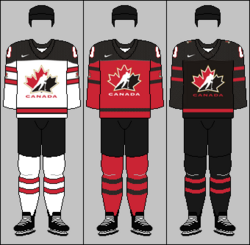 IIHF alternate jerseys 2018–present
 2022 Olympic jerseys
 IIHF jerseys 2023–present
 2026 Olympic jerseys
.png)
.png)
.png)


.png)

.png)


Notable jerseys
- Team Canada
 1928 Olympic jerseys
 1936 Olympic jerseys
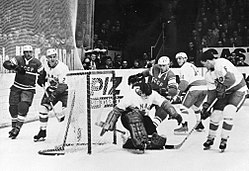 1964–1969 Olympic and IIHF jerseys
 1980 Olympic jerseys
 2002–2006 Olympic alternate jerseys
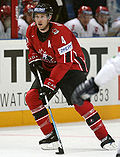 2007 IIHF jerseys
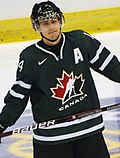 2010 IIHF alternate jerseys


See also

.svg)
Notes
- Replaced by Connor McDavid after Crosby was unable to play in the semi-finals and gold medal game due to injury.
- 6 gold medals were won at Olympic Games that also counted as IIHF World Championship titles
- 2 silver medals were won at Olympic Games that also counted as IIHF World Championship titles
- 2 bronze medals were won at Olympic Games that also counted as IIHF World Championship titles


