Capsicum baccatum
Species of plant
From Wikipedia, the free encyclopedia
Capsicum baccatum, also simply referred to as ají (Spanish: [aˈxi]), is a member of the genus Capsicum, and is one of the five domesticated chili pepper species. The fruit tends to be very pungent and registers 30,000 to 50,000 on the Scoville heat unit scale.

| Capsicum baccatum | |
|---|---|
| |
| Bishop's crown fruits | |
Scientific classification  | |
| Kingdom: | Plantae |
| Clade: | Tracheophytes |
| Clade: | Angiosperms |
| Clade: | Eudicots |
| Clade: | Asterids |
| Order: | Solanales |
| Family: | Solanaceae |
| Genus: | Capsicum |
| Species: | C. baccatum |
| Binomial name | |
| Capsicum baccatum | |
| Synonyms[1][2] | |
| |
Botany
Chili pepper varieties in the C. baccatum species have white or cream-colored flowers and typically have a green or gold corolla. The flowers are either insect or self-pollinated. The fruit pods of the baccatum species have been cultivated into a wide variety of shapes and sizes, unlike other capsicum species, which tend to have a characteristic shape. Unlike a Capsicum frutescens plant, the pods typically hang down and can have a citrus or fruity flavor.
Cultivated baccatum (C. baccatum var. pendulum) is the domesticated pepper of choice of Bolivia, Colombia, Ecuador, Peru, and Chile.[3] The Moche culture often represented fruits and vegetables in their art, including ají amarillo peppers.[4] South American farmers also grow C. baccatum as ornamental plants for export.[5]
Cultivars

This species of chili pepper includes the following cultivars:
- Ají amarillo, also called amarillo chili and ají escabeche[5]
- Bishop's crown
- Lemon drop, ají limón or ají limo[6]
- Piquanté pepper
 Capsicum baccatum flower
 Bishop's crown fruit on the plant
 Flower
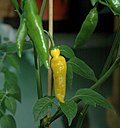 Cultivar "Lemon Drop"


Culinary use
The C. baccatum species, notably the ají amarillo chili, has its origins in ancient Peru and across the Andean region of South America.[7] It is typically associated with Peruvian cuisine, and is considered part of its condiment trinity together with red onion and coriander. Ají amarillo literally means "yellow chili"; however, the yellow color appears only when cooked, as the mature pods are bright orange.
Ají amarillo is one of the ingredients of Peruvian and Bolivian cuisines. It is used as a condiment, especially in many dishes and sauces. In Peru, the chilis are mostly used fresh, and in Bolivia, dried and ground. Common dishes with ají amarillo are the Peruvian stew ají de gallina ("hen chili"), Papa a la Huancaína, and the Bolivian fricasé Paceño, among others. In Ecuadorian cuisine, ají amarillo, onion, and lemon juice (amongst others) are served in a separate bowl with many meals as an optional condiment. In Colombian, Peruvian, and Ecuadorian cuisines, ají sauce is also a common condiment.
The Ají Amarillo pepper has been named the "Flavor of the Year" for 2025 by McCormick & Company, a prominent spice company. This pepper is expected to see a 59% increase in menu appearances over the next four years.[8]
Capsicum baccatum var. pendulum, popularly known as dedo-de-moça (lady-finger) is specially used on Brazilian cuisine, specially in the South and Southeast regions.[9][10]
Etymology

Some form of the word ají has been used since approximately 4600 BCE. It was first used in the protolanguage Otomanguean. It then spread along with the Capsicum fruit from Central and South America to other pepper-growing regions. Capsicum baccatum is still referred to as ají, while other peppers are referred to as "pepper" via the Spanish conquistadors noting the similarity in heat sensation to black pepper.[11]
The Latin binomial name is composed of Capsicum, from the Greek kapos, and Baccatum, meaning "berry-like."
See also
