Carathéodory function
From Wikipedia, the free encyclopedia
In mathematical analysis, a Carathéodory function (or Carathéodory integrand) is a multivariable function that allows us to solve the following problem effectively: A composition of two Lebesgue-measurable functions does not have to be Lebesgue-measurable as well. Nevertheless, a composition of a measurable function with a continuous function is indeed Lebesgue-measurable, but in many situations, continuity is a too restrictive assumption. Carathéodory functions are more general than continuous functions, but still allow a composition with Lebesgue-measurable function to be measurable. Carathéodory functions play a significant role in calculus of variation, and it is named after the Greek mathematician Constantin Carathéodory.
, for endowed with the Lebesgue measure, is a Carathéodory function if:


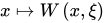
1. The mapping is Lebesgue-measurable for every .

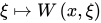
2. the mapping is continuous for almost every .

The main merit of Carathéodory function is the following: If is a Carathéodory function and is Lebesgue-measurable, then the composition is Lebesgue-measurable.[1]




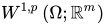


![{\displaystyle {\mathcal {F}}\left[u\right]=\int _{\Omega }W\left(x,u\left(x\right),\nabla u\left(x\right)\right)dx}](https://wikimedia.org/api/rest_v1/media/math/render/svg/819348cf627746f4d196bb5da5b3f342846c13d8)




