Cardiac index
From Wikipedia, the free encyclopedia
The cardiac index (CI) is a hemodynamic measure that represents the cardiac output (CO) of an individual divided by their body surface area (BSA), expressed in liters per minute per square meter (L/min/m2). This parameter provides a more accurate assessment of heart function relative to the size of the individual, as opposed to absolute cardiac output alone. Cardiac index is crucial in assessing patients with heart failure and other cardiovascular conditions, providing insight into the adequacy of cardiac function in relation to the individual's metabolic needs.[1]
Body surface area calculation
The index is usually calculated using the following formula:[2]
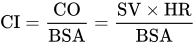
where
- CI - Cardiac index
- BSA - Body surface area
- SV - Stroke volume
- HR - Heart rate
- CO - Cardiac output
The cardiac index is adjusted for body surface area (BSA), typically calculated using the Mosteller formula. This adjustment allows for standardized comparison across individuals with different body sizes, improving the accuracy of CI measurements.[3]

Clinical significance
Cardiac index is a critical parameter in evaluating cardiac performance and the adequacy of tissue perfusion. In healthy adults, the normal range of cardiac index is generally between 2.6 and 4.2 L/min/m2. However, in healthy older adults, a range of 2.1 to 3.2 L/min/m2 has been defined.[4] Values below the normal range may indicate hypoperfusion and are often seen in conditions such as heart failure, hypovolemia, and cardiogenic shock. Conversely, elevated cardiac index values may be observed in hyperdynamic states, such as systemic inflammatory response syndrome (SIRS) or in patients with anemia. The cardiac index is thus a valuable tool in guiding therapeutic interventions in various clinical settings, including intensive care units.[5]
In clinical practice, CI helps tailor therapies such as the administration of vasopressors in septic shock based on real-time assessments from tools like bedside echocardiograms. This metric is essential for evaluating heart performance relative to the body's needs rather than in isolation, making it a key factor in managing various forms of shock.[6]
There are four main types of shock where CI plays a crucial role:[7]
- Cardiogenic shock: Resulting from heart dysfunction, such as myocardial infarction or heart failure, cardiogenic shock shows a decreased CI due to failure of pump action. An increase in systemic vascular resistance (SVR) is usually observed as the body attempts to compensate for this.
- Obstructive shock: Caused by obstructions like cardiac tamponade or massive pulmonary embolism, this type of shock also presents with a decreased CI and a compensatory increase in SVR.
- Hypovolemic shock: This occurs due to significant fluid loss (e.g., hemorrhage or burns), leading to decreased CI and compensatory increase in SVR.
- Distributive shock: Seen in conditions like septic or anaphylactic shock, the systemic inflammatory response causes widespread vasodilation, leading to decreased SVR, with resultant decrease in CI. The body in this case usually attempts to compensate by increasing the heart rate (HR).
CI is not only important in acute care settings but also in long-term health outcomes. Research, including the Framingham Heart Study, has linked low CI with an increased risk of dementia and Alzheimer's disease.[8] Additionally, higher CI in organ donors has been associated with improved survival rates in heart transplant recipients.[9]
Measurement techniques
Cardiac index can be assessed using a variety of methods, which can be broadly categorized into noninvasive imaging and invasive techniques. The choice of method depends on the patient's condition, the specific clinical requirements, and the desired balance between accuracy and procedural risk.[10][11]
Noninvasive techniques
- Doppler ultrasound: This method estimates blood flow and volume by analyzing the Doppler shift of ultrasound waves. It is cost-effective and provides rapid results, though its accuracy is dependent on the operator's skill.
- Echocardiography: By combining two-dimensional ultrasound with Doppler measurements, this technique evaluates cardiac function non-invasively. It is highly accurate but requires experienced operators and is more expensive than Doppler ultrasound.[12]
- Modified CO2 Fick method: This approach estimates cardiac output by measuring CO2 levels in patients on mechanical ventilation. While accurate, it is limited to specific patient populations and does not measure preload indices.
- Cardiac MRI: A comprehensive imaging modality that provides detailed assessments of cardiac structure and function, including CI. It is highly accurate but expensive and less accessible than other methods.[13]
Invasive techniques
- Oxygen Fick method: This method uses the Fick equation to directly measure cardiac output through pulmonary artery catheterization. It offers high precision but is invasive, time-consuming, and carries risks such as infection and arrhythmias.
- Lithium dilution cardiac output: This technique involves injecting lithium chloride and measuring its dilution in the bloodstream. It provides accurate results but requires multiple measurements and is invasive.[14]
- FloTrac system: A minimally invasive device that continuously monitors hemodynamic parameters by analyzing arterial waveform data. It is useful in critical care but less accurate in patients with low cardiac output or certain conditions like advanced liver disease.[15]
References
- ↑ Carlsson, Marcus; Andersson, Ruslana; Markenroth Bloch, Karin; Steding-Ehrenborg, Katarina; Mosén, Henrik; Stahlberg, Freddy; Ekmehag, Bjorn; Arheden, Hakan (2012). "Cardiac output and cardiac index measured with cardiovascular magnetic resonance in healthy subjects, elite athletes and patients with congestive heart failure". Journal of Cardiovascular Magnetic Resonance. 14 (1): 50. doi:10.1186/1532-429X-14-51. PMC 3419124. PMID 22839436.
- ↑ Del Rio-Pertuz, Gaspar; Nugent, Kenneth; Argueta-Sosa, Erwin (2023-06-25). "Right heart catheterization in clinical practice: a review of basic physiology and important issues relevant to interpretation". American Journal of Cardiovascular Disease. 13 (3): 122–137. ISSN 2160-200X. PMC 10352814. PMID 37469534.
- ↑ Redlarski, Grzegorz; Palkowski, Aleksander; Krawczuk, Marek (2016-06-21). "Body surface area formulae: an alarming ambiguity". Scientific Reports. 6 (1) 27966. Bibcode:2016NatSR...627966R. doi:10.1038/srep27966. ISSN 2045-2322. PMC 4914842. PMID 27323883.
- ↑ Cioccari L, Luethi N, Glassford NJ, Bellomo R (March 2019). "The normal cardiac index in older healthy individuals: a scoping review". Crit Care Resusc. 21 (1): 9–17. PMID 30857507.
- ↑ Reddy, Yogesh N.V.; Melenovsky, Vojtech; Redfield, Margaret M.; Nishimura, Rick A.; Borlaug, Barry A. (2016). "High-Output Heart Failure". Journal of the American College of Cardiology. 68 (5): 473–482. doi:10.1016/j.jacc.2016.05.043. PMID 27470455.
- ↑ Abdalaziz, Faten A.; Algebaly, Hebat Allah Fadel; Ismail, Reem Ibrahim; El-Sherbini, Seham Awad; Behairy, Ahmed (2018). "The use of bedside echocardiography for measuring cardiac index and systemic vascular resistance in pediatric patients with septic shock". Revista Brasileira de Terapia Intensiva. 30 (4): 460–470. doi:10.5935/0103-507X.20180067. ISSN 0103-507X. PMC 6334480. PMID 30672970.
- ↑ Lee, En-Pei; Hsia, Shao-Hsuan; Lin, Jainn-Jim; Chan, Oi-Wa; Lee, Jung; Lin, Chia-Ying; Wu, Han-Ping (2017). "Hemodynamic Analysis of Pediatric Septic Shock and Cardiogenic Shock Using Transpulmonary Thermodilution". BioMed Research International. 2017: 1–7. doi:10.1155/2017/3613475. ISSN 2314-6133. PMC 5376469. PMID 28401152.
- ↑ Jefferson, Angela L.; Beiser, Alexa S.; Himali, Jayandra J.; Seshadri, Sudha; O'Donnell, Christopher J.; Manning, Warren J.; Wolf, Philip A.; Au, Rhoda; Benjamin, Emelia J. (2015-04-14). "Low Cardiac Index Is Associated With Incident Dementia and Alzheimer Disease: The Framingham Heart Study". Circulation. 131 (15): 1333–1339. doi:10.1161/CIRCULATIONAHA.114.012438. ISSN 0009-7322. PMC 4398627. PMID 25700178.
- ↑ Pasrija, Chetan; Kon, Zachary N.; Shah, Aakash; Holmes, Sari D.; Rozenberg, Karina S.; Joseph, Susan; Griffith, Bartley P. (2023). "Indexed donor cardiac output for improved size matching in heart transplantation: A United Network for Organ Sharing database analysis". JTCVS Open. 15: 291–299. doi:10.1016/j.xjon.2023.04.021. PMC 10556824. PMID 37808019.
- ↑ Cariou, Alain; Monchi, Mehran; Joly, Luc-Marie; Bellenfant, Florence; Claessens, Yann-Eric; Thebert, Dominique; Brunet, Fabrice; Dhainaut, Jean-Francois (1998). "Noninvasive cardiac output monitoring by aortic blood flow determination: Evaluation of the Sometec Dynemo-3000 system". Critical Care Medicine. 26 (12): 2066–2072. doi:10.1097/00003246-199812000-00043. ISSN 0090-3493. PMID 9875922.
- ↑ Carlsson, Marcus; Andersson, Ruslana; Markenroth Bloch, Karin; Steding-Ehrenborg, Katarina; Mosén, Henrik; Stahlberg, Freddy; Ekmehag, Bjorn; Arheden, Hakan (2012-01-06). "Cardiac output and cardiac index measured with cardiovascular magnetic resonance in healthy subjects, elite athletes and patients with congestive heart failure". Journal of Cardiovascular Magnetic Resonance. 14 (1): 50. doi:10.1186/1532-429X-14-51. ISSN 1097-6647. PMC 3419124. PMID 22839436.
- ↑ Godley, Robert W.; Green, Debbie; Dillon, James C.; Rogers, Edwin W.; Feigenbaum, Harvey; Weyman, Arthur E. (1981). "Reliability of Two-dimensional Echocardiography in Assessing the Severity of Valvular Aortic Stenosis". Chest. 79 (6): 657–662. doi:10.1378/chest.79.6.657. PMID 7226954.
- ↑ Rajiah, Prabhakar Shantha; François, Christopher J.; Leiner, Tim (2023-05-01). "Cardiac MRI: State of the Art". Radiology. 307 (3) e223008. doi:10.1148/radiol.223008. ISSN 0033-8419. PMID 37039684.
- ↑ Jonas, Max M.; Tanser, Suzie J. (2002). "Lithium dilution measurement of cardiac output and arterial pulse waveform analysis: an indicator dilution calibrated beat-by-beat system for continuous estimation of cardiac output". Current Opinion in Critical Care. 8 (3): 257–261. doi:10.1097/00075198-200206000-00010. ISSN 1070-5295. PMID 12386506.
- ↑ Argueta, Erwin; Berdine, Gilbert; Pena, Camilo; Nugent, Kenneth M. (2015). "FloTrac® Monitoring System: What Are Its Uses in Critically III Medical Patients?". The American Journal of the Medical Sciences. 349 (4): 352–356. doi:10.1097/MAJ.0000000000000393. PMID 25584624.
| Heart |
| ||||||||||||
|---|---|---|---|---|---|---|---|---|---|---|---|---|---|
| Vascular system/ hemodynamics |
| ||||||||||||