Cavitation modelling
From Wikipedia, the free encyclopedia
Cavitation modelling is a type of computational fluid dynamic (CFD) that represents the flow of fluid during cavitation. It covers a wide range of applications, such as pumps, water turbines, pump inducers, and fuel cavitation in orifices as commonly encountered in fuel injection systems.
Vapor transport model
Modelling efforts can be divided into two broad categories: vapor transport models and discrete bubble models.
Vapor transport models are best suited to large-scale cavitation, like sheet cavitation that often occurs on rudders and propellers. These models include two-way interactions between the phases.
Discrete bubble model
The discrete bubble model includes the effects of the surrounding fluid on the bubbles. Discrete bubble models, e.g. the Rayleigh-Plesset,[1][2] Gilmore [3] and Keller-Miksis,[4] describe the relation between the external pressure, bubble radius and the velocity and acceleration of the bubble wall.
Two-phase modeling
Two-phase modeling is the modelling of the two phases, as in a free surface code. Two common types of two phase models are homogeneous mixture models and sharp interface models. The difference between both the models is in the treatment of the contents of cells containing both phases.
Homogeneous mixture models
Most recent cavitation modelling efforts have used homogeneous mixture models, in which the contents of individual cells are assumed to be uniform. This approach is best suited to modeling large numbers of bubbles that are much smaller than one cell. The disadvantage of this approach is that when the cavities are larger than one cell, the vapor fraction is diffused across neighboring cells by the vapor transport model.
This is different from the sharp interface models in that the vapor and liquid are modeled as distinct phases separated by an interface.
Sharp interface models
In sharp interface models, the interface is not diffused by advection. The model maintains a sharp interface. Naturally, this is only appropriate when the bubble size is at least on the order of a few cells.
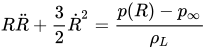
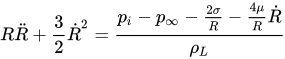

![{\displaystyle H={\frac {n}{n-1}}{\frac {p_{\infty }(t)+B}{\rho _{L}}}\left[({\frac {P+B}{p_{\infty }(t)+B}})^{\frac {n-1}{n}}-1\right]}](https://wikimedia.org/api/rest_v1/media/math/render/svg/238a250fd355f33a8515e6ffb521dccecf82bef7)
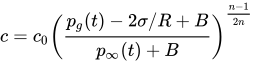
![{\displaystyle {\dot {H}}={\frac {D}{p_{\infty }(t)+B}}H-{\frac {D}{\rho }}({\frac {P+B}{p_{\infty }(t)+B}})^{\frac {n-1}{n}}+{\frac {\dot {R}}{\rho _{L}R}}\left[{\frac {p_{\infty }(t)+B}{P+B}}\right]^{\frac {1}{n}}\left[{\frac {2\sigma }{R}}-3kp_{g}(t)\right]}](https://wikimedia.org/api/rest_v1/media/math/render/svg/55033edaba2408de4e2f052a5b344179457fbad5)