Cellular algebra
From Wikipedia, the free encyclopedia
In abstract algebra, a cellular algebra is a finite-dimensional associative algebra A with a distinguished cellular basis which is particularly well-adapted to studying the representation theory of A.
The cellular algebras discussed in this article were introduced in a 1996 paper of Graham and Lehrer.[1] However, the terminology had previously been used by Weisfeiler and Lehman in the Soviet Union in the 1960s, to describe what are also known as coherent algebras. [2][3][4]
Definitions
Let be a fixed commutative ring with unit. In most applications this is a field, but this is not needed for the definitions. Let also be an -algebra.


The concrete definition
A cell datum for is a tuple consisting of

- A finite partially ordered set .
- A -linear anti-automorphism with .
- For every a non-empty finite set of indices.
- An injective map
- The images under this map are notated with an upper index and two lower indices so that the typical element of the image is written as .
- and satisfying the following conditions:





- The image of is a -basis of .
- for all elements of the basis.
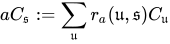
- For every , and every the equation


- with coefficients depending only on , and but not on . Here denotes the -span of all basis elements with upper index strictly smaller than .



This definition was originally given by Graham and Lehrer who invented cellular algebras.[1]
The more abstract definition
Let be an anti-automorphism of -algebras with (just called "involution" from now on).

A cell ideal of with respect to is a two-sided ideal that satisfies the following.


- .
- There is a left ideal that is free as a -module and an isomorphism


- of --bimodules such that and are compatible in the sense that



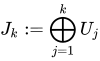
A cell chain for with respect to is defined as a direct decomposition

into free -submodules such that
- is a two-sided ideal of
- is a cell ideal of w.r.t. the induced involution.



Now is called a cellular algebra if it has a cell chain. One can show that the two definitions are equivalent.[5] Every basis gives rise to cell chains (one for each topological ordering of ) and choosing a basis of every left ideal one can construct a corresponding cell basis for .


Examples
Polynomial examples
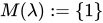
is cellular. A cell datum is given by and
![{\displaystyle R[x]/(x^{n})}](https://wikimedia.org/api/rest_v1/media/math/render/svg/4f607b7141a8cc500dbdf3e073d667febd2eba66)

- with the reverse of the natural ordering.


A cell-chain in the sense of the second, abstract definition is given by
![{\displaystyle 0\subseteq (x^{n-1})\subseteq (x^{n-2})\subseteq \ldots \subseteq (x^{1})\subseteq (x^{0})=R[x]/(x^{n})}](https://wikimedia.org/api/rest_v1/media/math/render/svg/3db6a0cfdb59ebc032f5a47fbe9f9bb9a3910ae4)
Matrix examples
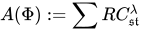
is cellular. A cell datum is given by and


- For the basis one chooses the standard matrix units, i.e. is the matrix with all entries equal to zero except the (s,t)-th entry which is equal to 1.




A cell-chain (and in fact the only cell chain) is given by

In some sense all cellular algebras "interpolate" between these two extremes by arranging matrix-algebra-like pieces according to the poset .
Further examples
Modulo minor technicalities all Iwahori–Hecke algebras of finite type are cellular with respect to the involution that maps the standard basis as .[6] This includes for example the integral group algebra of the symmetric groups as well as all other finite Weyl groups.

A basic Brauer tree algebra over a field is cellular if and only if the Brauer tree is a straight line (with arbitrary number of exceptional vertices).[5]
Further examples include q-Schur algebras, the Brauer algebra, the Temperley–Lieb algebra, the Birman–Murakami–Wenzl algebra, the blocks of the Bernstein–Gelfand–Gelfand category of a semisimple Lie algebra.[5]