Central triangle
From Wikipedia, the free encyclopedia
In geometry, a central triangle is a triangle in the plane of the reference triangle. The trilinear coordinates of its vertices relative to the reference triangle are expressible in a certain cyclical way in terms of two functions having the same degree of homogeneity. At least one of the two functions must be a triangle center function. The excentral triangle is an example of a central triangle. The central triangles have been classified into three types based on the properties of the two functions.
Triangle center function
A triangle center function is a real valued function of three real variables u, v, w having the following properties:

- Homogeneity property: for some constant n and for all t > 0. The constant n is the degree of homogeneity of the function
- Bisymmetry property:



Central triangles of Type 1
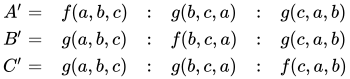
Let and be two triangle center functions, not both identically zero functions, having the same degree of homogeneity. Let a, b, c be the side lengths of the reference triangle △ABC. An (f, g)-central triangle of Type 1 is a triangle △A'B'C' the trilinear coordinates of whose vertices have the following form:[1][2][better source needed]


Central triangles of Type 2
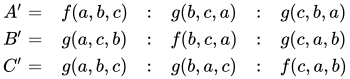
Let be a triangle center function and be a function function satisfying the homogeneity property and having the same degree of homogeneity as but not satisfying the bisymmetry property. An (f, g)-central triangle of Type 2 is a triangle △A'B'C' the trilinear coordinates of whose vertices have the following form:[1][better source needed]
Central triangles of Type 3
Let be a triangle center function. An g-central triangle of Type 3 is a triangle △A'B'C' the trilinear coordinates of whose vertices have the following form:[1][better source needed]
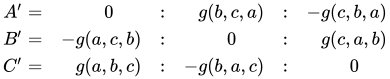
This is a degenerate triangle in the sense that the points A', B', C' are collinear.




