Cephalocereus euphorbioides
From Wikipedia, the free encyclopedia
| Cephalocereus euphorbioides | |
|---|---|
 | |
Scientific classification  | |
| Kingdom: | Plantae |
| Clade: | Tracheophytes |
| Clade: | Angiosperms |
| Clade: | Eudicots |
| Order: | Caryophyllales |
| Family: | Cactaceae |
| Subfamily: | Cactoideae |
| Genus: | Cephalocereus |
| Species: | C. euphorbioides |
| Binomial name | |
| Cephalocereus euphorbioides (Haw.) Britton & Rose | |
 | |
| Synonyms | |
| |

Cephalocereus euphorbioides is a species of Cephalocereus from Mexico.
Cephalocereus euphorbioides grows with rarely branching green shoots 3 to 5 meters tall and 10 to 11 centimeters in diameter. The 8 to 10 noticeable ribs are clearly wavy. The thorns are only upright in the flower zone and are otherwise more or less horizontal. The single, strong central spine is dark brown and up to 3 centimeters long. The 7 to 9 straight, light gray marginal spines have a darker tip and are 5 to 12 millimeters long.
The narrow, bell-shaped flowers usually appear in large numbers near the tips of the shoots. They are reddish pink, 5 to 8 centimeters long and reach 7 centimeters in diameter. Its pericarpel and floral tube are covered with small tubercles with nectar glands and small scales. The green fruits are up to 8 centimeters long.[2]
 Plant
Plant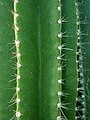 Spines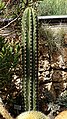


Distribution
Cephalocereus euphorbioides is distributed in the Mexican states of Tamaulipas, San Luis Potosí and Veracruz at elevations between 300 and 600 meters in dry forest. There are two disjunct populations one near Mante, Tamaulipas and the other near Jalapa, Veracruz.[3]


