Ceramic foam
From Wikipedia, the free encyclopedia
Ceramic foam is a tough foam made from ceramics. Manufacturing techniques include impregnating open-cell polymer foams internally with ceramic slurry and then firing in a kiln, leaving only ceramic material. The foams may consist of several ceramic materials such as aluminium oxide, a common high-temperature ceramic, and gets insulating properties from the many tiny air-filled voids within the material.
The foam can be used not only for thermal insulation,[1] but for a variety of other applications such as acoustic insulation,[1] absorption of environmental pollutants,[1] filtration of molten metal alloys,[2] and as substrate for catalysts requiring large internal surface area.
It has been used as stiff lightweight structural material, specifically for support of reflecting telescope mirrors.
Ceramic foams are hardened ceramics with pockets of air or another gas trapped in pores throughout the body of the material. With its ability to create a large specific surface area, these materials can be fabricated as high as 94 to 96% air by volume with temperature resistances as high as 1700 °C.[1] Because many ceramics are already oxides or other inert compounds, there is little danger of oxidation or reduction of the material.[3]
Previously, pores had been avoided in ceramic components due to their brittle properties.[4] However, in practice ceramic foams have somewhat advantageous mechanical properties, showing high strength and plastic toughness, compared to bulk ceramics. One example is crack propagation, given by:
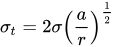
where σt is the stress at the tip of the crack, σ is the applied stress, a is the crack size and r is the radius of curvature. For certain stress applications, this means ceramic foams actually outperform bulk ceramics because the porous pockets of air act to blunt the crack tip radius, leading to a disruption of its propagation and a decrease in the likelihood of failure.[5]
Preparation methods
Organic foam impregnating method
The organic foam impregnating method is one of the more widely used in industry, creating the ceramic foam with a 3D mesh skeleton structure and coat a ceramic slurry on a polyurethane organic foam mesh body. The ceramic foam is obtained by allowing the body to dry at room temperature and burn the mesh body to retrieve the ceramic foam. This method is best used to prepare silicon carbide foam ceramics.[6]
Foaming Method
The foaming method uses a chemical reaction of a foaming agent. The foaming agent generates volatile gas that foams the slurry. The slurry is dried and sintered to obtain the ceramic foam. The product’s shape and density can be controlled and manipulated with the foaming method. This method can be used in the preparation of small pore size closed cell ceramics.[6]