Change of variables (PDE)
From Wikipedia, the free encyclopedia
Often a partial differential equation can be reduced to a simpler form with a known solution by a suitable change of variables.
The article discusses change of variable for PDEs below in two ways:
- by example;
- by giving the theory of the method.
For example, the following simplified form of the Black–Scholes PDE

is reducible to the heat equation

by the change of variables:

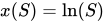
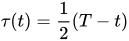

in these steps:
- Replace by and apply the chain rule to get

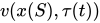

- Replace and by and to get



- Replace and by and and divide both sides by to get

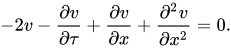
- Replace by and divide through by to yield the heat equation.



Advice on the application of change of variable to PDEs is given by mathematician J. Michael Steele:[1]
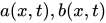
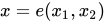
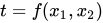
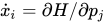
"There is nothing particularly difficult about changing variables and transforming one equation to another, but there is an element of tedium and complexity that slows us down. There is no universal remedy for this molasses effect, but the calculations do seem to go more quickly if one follows a well-defined plan. If we know that satisfies an equation (like the Black–Scholes equation) we are guaranteed that we can make good use of the equation in the derivation of the equation for a new function defined in terms of the old if we write the old V as a function of the new v and write the new and x as functions of the old t and S. This order of things puts everything in the direct line of fire of the chain rule; the partial derivatives , and are easy to compute and at the end, the original equation stands ready for immediate use."