Chessboard complex
From Wikipedia, the free encyclopedia
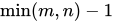
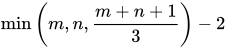
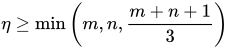
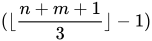
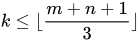
A chessboard complex is a particular kind of abstract simplicial complex, which has various applications in topological graph theory and algebraic topology.[1][2] Informally, the (m, n)-chessboard complex contains all sets of positions on an m-by-n chessboard, where rooks can be placed without attacking each other. Equivalently, it is the matching complex of the (m, n)-complete bipartite graph, or the independence complex of the m-by-n rook's graph.
For any two positive integers m and n, the (m, n)-chessboard complex is the abstract simplicial complex with vertex set that contains all subsets S such that, if and are two distinct elements of S, then both and . The vertex set can be viewed as a two-dimensional grid (a "chessboard"), and the complex contains all subsets S that do not contain two cells in the same row or in the same column. In other words, all subset S such that rooks can be placed on them without taking each other.

![{\displaystyle [m]\times [n]}](https://wikimedia.org/api/rest_v1/media/math/render/svg/c14a20bf5b043a4e205b77fff7418a4e8aab0bbc)


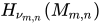
The chessboard complex can also be defined succinctly using deleted join. Let Dm be a set of m discrete points. Then the chessboard complex is the n-fold 2-wise deleted join of Dm, denoted by .[3]: 176

Another definition is the set of all matchings in the complete bipartite graph .[1]

Examples
In any (m,n)-chessboard complex, the neighborhood of each vertex has the structure of a (m − 1,n − 1)-chessboard complex. In terms of chess rooks, placing one rook on the board eliminates the remaining squares in the same row and column, leaving a smaller set of rows and columns where additional rooks can be placed. This allows the topological structure of a chessboard to be studied hierarchically, based on its lower-dimensional structures. An example of this occurs with the (4,5)-chessboard complex, and the (3,4)- and (2,3)-chessboard complexes within it:[4]
- The (2,3)-chessboard complex is a hexagon, consisting of six vertices (the six squares of the chessboard) connected by six edges (pairs of non-attacking squares).
- The (3,4)-chessboard complex is a triangulation of a torus, with 24 triangles (triples of non-attacking squares), 36 edges, and 12 vertices. Six triangles meet at each vertex, in the same hexagonal pattern as the (2,3)-chessboard complex.
- The (4,5)-chessboard complex forms a three-dimensional pseudomanifold: in the neighborhood of each vertex, 24 tetrahedra meet, in the pattern of a torus, instead of the spherical pattern that would be required of a manifold. If the vertices are removed from this space, the result can be given a geometric structure as a cusped hyperbolic 3-manifold, topologically equivalent to the link complement of a 20-component link.