Chimaericola leptogaster
From Wikipedia, the free encyclopedia
| Chimaericola leptogaster | |
|---|---|
.png) | |
Scientific classification  | |
| Domain: | Eukaryota |
| Kingdom: | Animalia |
| Phylum: | Platyhelminthes |
| Class: | Monogenea |
| Order: | Chimaericolidea |
| Family: | Chimaericolidae |
| Genus: | Chimaericola |
| Species: | C. leptogaster |
| Binomial name | |
| Chimaericola leptogaster (Leuckart, 1830) Brinkmann, 1942 | |
| Synonyms | |
| |
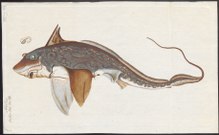
Chimaericola leptogaster is a species of polyopisthocotylean monogenean in the family Chimaericolidae. It is ectoparasitic on the gills of the chimaera Chimaera monstrosa.
According to Brinkmann,[1] the species was discovered as early as 1828 on the gills of chimaeras off Norway by Rapp and was given a scientific name by Friedrich Sigismund Leuckart in 1830, as Octobothrium leptogaster, but Leuckart did not see the animal. The species was then mentioned by Félix Dujardin[2] and Karl Moriz Diesing,[3] who also did not see the specimens. However, Diesing transferred the species to the genus Discocotyle but also considered the species as "species inquirenda". Later, in 1858, Diesing transferred the species to the genus Placoplectanum. Olsson redescribed the animal in 1876 [4] and used again the name Octobothrium leptogaster. The species was shortly redescribed by Parona & Perugia in 1892.
Finally Brinkmann redescribed the species in details in 1942 [1] from material collected off Norway and Sweden.
.png)

