Chirikov criterion
From Wikipedia, the free encyclopedia
The Chirikov criterion or Chirikov resonance-overlap criterion was established by the Russian physicist Boris Chirikov. Back in 1959, he published a seminal article,[1] where he introduced the very first physical criterion for the onset of chaotic motion in deterministic Hamiltonian systems. He then applied such a criterion to explain puzzling experimental results on plasma confinement in magnetic bottles obtained by Rodionov at the Kurchatov Institute.
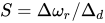
According to this criterion a deterministic trajectory will begin to move between two nonlinear resonances in a chaotic and unpredictable manner, in the parameter range

Here is the perturbation parameter, while is the resonance-overlap parameter, given by the ratio of the unperturbed resonance width in frequency (often computed in the pendulum approximation and proportional to the square-root of perturbation), and the frequency difference between two unperturbed resonances. Since its introduction, the Chirikov criterion has become an important analytical tool for the determination of the chaos border.