Chuncheon
City in Gangwon, South Korea
From Wikipedia, the free encyclopedia
Chuncheon (Korean: 춘천; Korean pronunciation: [tɕʰun.tɕʰʌn]) is the capital of the state of Gangwon Province, South Korea. Its population is about 290,000 as of 2026. The city lies in the north of the country, located in a basin surrounded by the Soyang River and Han River. There are artificial lakes in the city such as Soyang Lake and Uiam Lake. Gangwon Provincial Office is located in the city.

 South Korea
Chuncheon
춘천 | |
|---|---|
| Korean transcription(s) | |
| • Hangul | 춘천시 |
| • Hanja | 春川市 |
| • Revised Romanization | Chuncheon-si |
| • McCune–Reischauer | Ch'unch'ŏn-si |
Chuncheon City Hall | |
 Flag | |
 Location in South Korea | |
| Coordinates: 37°52′N 127°44′E | |
| Country | South Korea |
| State |  Gangwon Gangwon |
| Administrative divisions | 1 eup, 9 myeon, 15 dong |
| Government | |
| • Mayor | Yuk Dong-han (육동한) |
| Area | |
• Total | 1,166.8 km2 (450.5 sq mi) |
| Population (February 2026[2]) | |
• Total | 284,855 |
| • Density | 244.1/km2 (632/sq mi) |
| Area code | +82-33-2xx |
| Climate | Dwa |
History
People have lived in Chuncheon since the Paleolithic Age.
There are records that Maekguk (맥국; 貊國) was founded in Chuncheon but it seems to have been conquered by Goguryeo. In 637, Silla established Usu-ju (우수주; 牛首州) in Chuncheon but whether it was continuously its territory it is not known. After the unification of the Three Kingdoms of Korea, Silla established Suyak-ju (수약주; 首若州) in the region. In the reign of King Gyeongdeok, it was renamed to Sak-ju (삭주; 朔州).
In 940 (23th year of the reign of King Taejo), it was renamed to Chun-ju (춘주; 春州). In mid Goryeo, the region was invaded by Khitans, Mongols and wokou. In 1413 (13th year of the reign of King Taejong), it was renamed to Chuncheon-gun.[3]
In 1896, Chuncheon became the capital city of Gangwon province because of the establishment of the provincial office.[4] During the Battle of Chuncheon in 1950, the 6th Infantry Division of South Korea conducted a defense war for six days in Chuncheon and Hongcheon, delaying II Corps of North Korea's advance to the areas.[5]
In 1995, Chuncheon City was merged with Chuncheon County.
Industry
The service sector occupies a large proportion of Chuncheon's industry. As of 2015, the number of companies by industry is 4,434 in wholesale and retail, 4,890 in accommodation and restaurant, 1,609 in transportation, and 2,383 in public repair and personal service.
Chuncheon has little agricultural land as mountainous areas occupy more than 90% of the total area. Major agricultural products are rice in Sindong-myeon, Nam-myeon, and Sinbuk-eup and radish and cabbage in Sinbuk-eup, Seomyeon, and Sindong-myeon.[3]
There are three hydroelectric powerplants in Chuncheon, Uiam, and Soyang River. Chuncheon Dam, Uiam Dam, and Soyang Dam were built in 1965, 1967, and 1973 respectively.[6] Soyang Dam was the largest rockfill dam in East Asia.[7]
Population
Chuncheon's population has grown steadily over the past half century.
| Year | Pop. | ±% |
|---|---|---|
| 1965 | 191,576 | — |
| 1970 | 209,821 | +9.5% |
| 1975 | 204,246 | −2.7% |
| 1980 | 210,985 | +3.3% |
| 1985 | 213,198 | +1.0% |
| 1990 | 217,869 | +2.2% |
| 1995 | 233,016 | +7.0% |
| 2000 | 251,991 | +8.1% |
| 2005 | 256,455 | +1.8% |
| 2010 | 272,739 | +6.3% |
| 2015 | 281,005 | +3.0% |
| 2020 | 284,489 | +1.2% |
| Source: Chuncheon City (1965-2023)[8] | ||
Administrative divisions
|
  | ||||||||||||||||||||||||||||||||||||||||||||||||||||||||||||||||||||||||||||||||||||||||||||||||||||||||||||
Education
In the Joseon Dynastry, Chuncheon Hyanggyo was in Gyo-dong.
As of 2015, there are 42 elementary schools, 18 middle schools, 14 high schools, and 3 special schools. Also, there are 3 junior colleges (Korea Polytechnics III Campus, Hallym Sacred Heart University, and Songgok University), one university of education (Chuncheon National University of Education), two universities (Kangwon National University Chuncheon Campus and Hallym University), and Korea National Open University Gangwon Campus.[3]
Culture and tourism
Heritage
There are 12 state-designated and 34 province-designated cultural properties in Chuncheon.[11]
Cheongpyeongsa is a Buddhist temple established in 973. Its gate is designated as treasure.[12]
Food

Dak-galbi and mak-guksu are regional specialties of Chuncheon. Dakgalbi is made by cutting chicken into thin pieces, marinating it with various sauces, and grilling it. Unlike its name, ribs are not used. Kim Yeong-seok, a owner of a pork restaurant, is credited with inventing the dish in the 1960s when he used chicken instead when pork ran out. The recipe changed to adding various vegetables such as cabbage and onion and frying them on an iron plate.[13] Subsequently, Myeongdong Dakgalbi Alley was formed in the 1970s.[14] Mak-guksu are dark-colored noodles made from buckwheat. It was originally eaten in the winter as a late-night snack but began to be eaten in all seasons in the 1970s.[15]
Festivals
In April, Uiam Festival which began in 1985 is held to honor Ryu In-seok who organized an army against Japanese imperialism at the end of the Joseon Dynasty.[16] In May, Chuncheon Mime Festival which began in 1993 is held for the popularization and globalization of mime. It is considered one of the world's three major mime festivals with Mimos Festival of France and London International Mime Festival.[17] Chuncheon International Early Music Festival, which began in 1998, showcases Baroque music.[18]
Starting in June, Chuncheon Theater Festival which began in 1991 showcases comedy plays.[19] In August, visitors can participate in the makguksu eating competition and singing contest at the Chuncheon Dakgalbi & Makguksu Festival, which began in 1996 by Chuncheon City and KBS Chuncheon.[20] In Chuncheon Art Festival which began in 2002, overseas and domestic artists from different genres gather to present new works.[21] Chuncheon Puppet Festival, which began in 1989, is the biggest puppet festival in South Korea.[22]
In September, Soyang River Culture Festival which began in 1966 is held for the succession of local culture and regional harmony.[23] In October, Chuncheon AniTown Festival which began in 1997 is held for the development of the animation industry.[24] In autumn, Gim Yujeong Literature Festival, which began in 2003, is held to honor novelist Gim Yujeong.[25]
Museum

Chuncheon National Museum opened in 2002 to preserve and exhibit the cultural properties of Gangwon.[26]
Resort
Legoland Korea Resort, the 10th Legoland theme park and the 2nd largest in the world, opened in 2022.[27]
In media
Because of the success of the 2002 drama Winter Sonata in Japan, Namiseom and Myeongdong were popular destinations for Japanese tourists.[28]
Sports
Chuncheon Songam Sports Town began operating in 2009. It has a sports complex that accommodates 25,000 people, an 8,500-seat baseball stadium, indoor and outdoor tennis courts, a Korean archery field, an ice rink and leisure facilities.[29]
Gangchon is a popular place to ski.[30]
Sports Clubs
Chuncheon FC, member of the K3 League, is a semi-professional football team. The club was founded in February 2010 with its home at the Chuncheon Stadium.[31]
High1 was an ice hockey team based in Chuncheon. The club was a member of the Asia League Ice Hockey between 2005 and 2019. Founded in 2004, it was dissolved in 2023.[32]
Sports events
There are three marathons in Chuncheon. Chuncheon National Inline Marathon is held to popularize inline skating.[33] Chosun Ilbo Chuncheon Marathon began in 1946 by Sohn Kee-chung and other athletes to train athletes.[34] Chuncheon Hoban Marathon is held to honor Ham Gi-yong who won the 1950 Boston Marathon.[35]
In Chuncheon Korea Open International Taekwondo Championships, athletes compete for championship in taekwondo.[36]
National MTB Gangchon Challenger Competition is a mountain bike racing festival.[37]
Transportation

Gyeongchun Line is a double-track railway that connects Mangu station in Seoul and Chuncheon.[38] Its stations located in Chuncheon are Baegyang-ri station, Gimyujeong station, Namchuncheon station, and Chuncheon station (terminus).[39]
Chuncheon is a transportation hub as National Route 5 and National Route 46 go through the region.[3] It is also the northern terminus of publicly funded Jungang Expressway[40] and the main destination of the privately run Seoul-Chuncheon Expressway. In 2017, the expressway was extended to Yangyang and thus renamed to Seoul-Yangyang Expressway.[41]
Chuncheon Intercity Bus Terminal operates 41 routes as of 2025.[42]
There are also passenger boats in Soyang Lake which connects to Cheongpyeongsa and Yanggu County.[43]
Nature
Chuncheon is a basin with Obong Mountain to the north, Samak Mountain in the west, Bonghwa mountain in the southwest, and Daeryong Mountain in the southeast.
Soyang River from the northeast and Bukhan River from the northwest join in the basin and flow southward. River islands such as Namiseom in Cheongpyeong Lake and Wido, Jungdo, and Bungeoseom in Uiam Lake are developed.[3]
Climate
Chuncheon has a monsoon-influenced humid continental climate (Köppen: Dwa)[44] with cold, dry winters and hot, rainy summers. The lowest measured temperature was −27.9 °C (−18 °F) (6 February 1969),[45] and the highest was 39.5 °C (103 °F) (1 August 2018).[46] The annual precipitation is an average of 1347.3 mm.
| Climate data for Chuncheon (1991–2020 normals, extremes 1966–present) | |||||||||||||
|---|---|---|---|---|---|---|---|---|---|---|---|---|---|
| Month | Jan | Feb | Mar | Apr | May | Jun | Jul | Aug | Sep | Oct | Nov | Dec | Year |
| Record high °C (°F) | 12.7 (54.9) |
19.9 (67.8) |
23.5 (74.3) |
32.0 (89.6) |
34.0 (93.2) |
36.4 (97.5) |
37.2 (99.0) |
39.5 (103.1) |
34.7 (94.5) |
28.5 (83.3) |
24.8 (76.6) |
16.6 (61.9) |
39.5 (103.1) |
| Mean daily maximum °C (°F) | 1.9 (35.4) |
5.4 (41.7) |
11.6 (52.9) |
18.9 (66.0) |
24.3 (75.7) |
28.1 (82.6) |
29.3 (84.7) |
29.9 (85.8) |
25.6 (78.1) |
19.6 (67.3) |
11.2 (52.2) |
3.5 (38.3) |
17.4 (63.3) |
| Daily mean °C (°F) | −4.1 (24.6) |
−1.0 (30.2) |
5.0 (41.0) |
11.7 (53.1) |
17.6 (63.7) |
22.2 (72.0) |
24.9 (76.8) |
25.0 (77.0) |
19.8 (67.6) |
12.7 (54.9) |
5.3 (41.5) |
−2.0 (28.4) |
11.4 (52.5) |
| Mean daily minimum °C (°F) | −9.3 (15.3) |
−6.7 (19.9) |
−1.1 (30.0) |
4.7 (40.5) |
11.3 (52.3) |
17.0 (62.6) |
21.3 (70.3) |
21.3 (70.3) |
15.3 (59.5) |
7.5 (45.5) |
0.4 (32.7) |
−6.6 (20.1) |
6.3 (43.3) |
| Record low °C (°F) | −25.6 (−14.1) |
−27.9 (−18.2) |
−16.2 (2.8) |
−6.4 (20.5) |
1.6 (34.9) |
5.6 (42.1) |
11.7 (53.1) |
11.3 (52.3) |
1.9 (35.4) |
−5.4 (22.3) |
−15.8 (3.6) |
−21.7 (−7.1) |
−27.9 (−18.2) |
| Average precipitation mm (inches) | 18.6 (0.73) |
27.6 (1.09) |
33.5 (1.32) |
71.5 (2.81) |
99.4 (3.91) |
122.9 (4.84) |
398.2 (15.68) |
319.9 (12.59) |
128.1 (5.04) |
49.3 (1.94) |
48.3 (1.90) |
24.2 (0.95) |
1,341.5 (52.81) |
| Average precipitation days (≥ 0.1 mm) | 6.2 | 5.9 | 7.3 | 8.3 | 9.1 | 9.9 | 15.6 | 14.0 | 8.3 | 6.0 | 8.0 | 7.5 | 106.1 |
| Average snowy days | 8.8 | 6.3 | 3.9 | 0.2 | 0.0 | 0.0 | 0.0 | 0.0 | 0.0 | 0.0 | 1.8 | 6.7 | 27.7 |
| Average relative humidity (%) | 68.0 | 63.2 | 60.6 | 58.8 | 65.0 | 70.6 | 80.0 | 80.5 | 78.2 | 76.2 | 73.3 | 71.5 | 70.5 |
| Mean monthly sunshine hours | 170.0 | 174.3 | 199.9 | 210.1 | 227.5 | 205.0 | 144.2 | 166.3 | 173.3 | 178.9 | 141.8 | 148.4 | 2,139.7 |
| Percentage possible sunshine | 54.1 | 56.6 | 53.3 | 54.5 | 50.2 | 45.3 | 32.1 | 40.1 | 46.6 | 50.0 | 46.4 | 50.0 | 47.7 |
| Source: Korea Meteorological Administration (snow and percent sunshine 1981–2010)[47][46][48] | |||||||||||||
Notable people
- Son Heung-min: professional footballer
- Hwang Hee-chan: professional footballer
- Hur Jae: basketball coach and former basketball player
- Kim Jun-hyun: comedian
- Park Bo-ram: singer-songwriter
- Seunghee: singer and actress, member of Oh My Girl
- Yebin: singer-songwriter, former member of DIA and Uni.T
- Changjo: singer-songwriter and actor, member of Teen Top
- Gim Yu-jeong: novelist
- Jin Jong-oh: Shooting sports athlete who competed at the 2004, 2008, 2012 and 2016 Summer Olympics
- Han Seung-soo: 39th prime minister of Rep. of Korea, tenure 2008–2009
- Minji: singer, member of NewJeans
Sister cities
| City | State | Country |
|---|---|---|
| Dongdaemun District, Gangnam District | Seoul | South Korea[49] |
| Goseong County | Gangwon Province | |
| Ansan | Gyeonggi Province | |
| Nam District | Gwangju | |
| Goheung County | South Jeolla Province | |
| Goseong County | South Gyeongsang Province | |
| Hōfu | Yamaguchi Prefecture |  Japan Japan |
| Kakamigahara | Gifu Prefecture | |
| Baoding | Hebei |  China China |
| Hangzhou | Zhejiang | |
| Dalian, Shenyang | Liaoning | |
| Changzhou | Jiangsu | |
| Nanyang | Henan | |
| Da Lat | Lam Dong |  Vietnam Vietnam |
| Parma | Emilia-Romagna |  Italy Italy |
| Vejle | Southern Denmark |  Denmark Denmark |
| Medellín | Antioquia Department |  Colombia Colombia |
| Addis Ababa |  Ethiopia[50] Ethiopia[50] | |
In March 2005, Chuncheon sent letters of protest to its sister cities in Japan (Kakamigahara, Higashichikuma, and Hofu) and indefinitely postponed culture exchange events in protest of the enactment of "Day of Takeshima" in Shimane Prefecture.[51] In October 2005, culture exchange events were resumed.[52]
Gallery
 Namiseom
 Soyang River Skywalk
 Samak Mountain
 Cheongpyeongsa
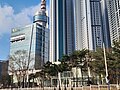 KBS Chuncheon
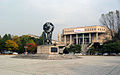 Kangwon National University
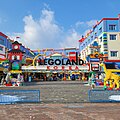 Legoland Korea
 Panoramic view of Chuncheon


