Circle packing in an equilateral triangle
From Wikipedia, the free encyclopedia
Circle packing in an equilateral triangle is a packing problem in discrete mathematics where the objective is to pack n unit circles into the smallest possible equilateral triangle. Optimal solutions have been proved for n ≤ 15, and for any triangular number of circles, and conjectures are available for n ≤ 34.[1][2][3][4]
A conjecture of Paul Erdős and Norman Oler states that, if n is a triangular number, then the optimal packings of n − 1 and of n circles have the same side length: that is, according to the conjecture, an optimal packing for n − 1 circles can be found by removing any single circle from the optimal hexagonal packing of n circles.[5] This conjecture is now known to be true for n ≤ 15.[6] In a paper by Graham and Lubachevsky concerning solutions for 22 ≤ n ≤ 34 they also conjectured seven infinite families of optimal solutions in addition to the one by Erdős and Oler. These families give conjectured solutions for many more numbers, including n = 37, 40, 42, 43, 46, 49.[3]
Minimum solutions for the side length of the triangle:[1]
| Number of circles |
Triangle number |
Length | Area | Figure |
|---|---|---|---|---|
| 1 | Yes | = 3.464... | 5.196... |  |
| 2 | = 5.464... | 12.928... |  | |
| 3 | Yes | = 5.464... | 12.928... |  |
| 4 | = 6.928... | 20.784... |  | |
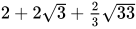
| 5 | = 7.464... | 24.124... |  | |
| 6 | Yes | = 7.464... | 24.124... |  |
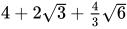
| 7 | = 8.928... | 34.516... |  | |
| 8 | = 9.293... | 37.401... |  | |
| 9 | = 9.464... | 38.784... |  | |
| 10 | Yes | = 9.464... | 38.784... |  |
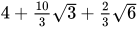
| 11 | = 10.730... | 49.854... |  | |
| 12 | = 10.928... | 51.712... |  | |
| 13 | = 11.406... | 56.338... |  | |
| 14 | = 11.464... | 56.908... |  | |
| 15 | Yes | = 11.464... | 56.908... |  |





A closely related problem is to cover the equilateral triangle with a fixed number of equal circles, having as small a radius as possible.[7]
