Clara Sansoni
From Wikipedia, the free encyclopedia
Clara Sansoni | |
|---|---|
 Sansoni c. 1911 | |
| Born | 29 June 1893 Pistoia, Kingdom of Italy |
| Died | 23 April 1977 (aged 83) Florence, Italy |
| Education | Isaac Albéniz and Francis Planté |
| Occupation | Classical pianist |
| Years active | 1904 – c. 1924 |
| Known for |
|
Clara Sansoni (29 June 1893 – 23 April 1977) was an Italian pianist, noted as a primary exponent of the Spanish-French piano school. A child prodigy who debuted at the Salle Érard in Paris at just thirteen, she became a particularly favoured student and close associate of Isaac Albéniz.
Centring her career primarily in Italy and France, Sansoni gained distinction for her mastery of Albéniz's masterwork, Iberia. She notably gave the London premiere of the complete cycle in 1909, navigating technical hurdles that the composer himself reportedly found nearly unplayable. Her style – a fusion of the clear, floating tone of her French mentor Francis Planté and Albéniz's rhythmic impressionism – earned her sustained acclaim over a career spanning two decades.
While her international appearances became less frequent following the First World War, her historical significance as a primary interpreter of Albéniz's work was formally recognised by UNESCO in 1960. A private recording from 1971 remains the only late-period document of her pianistic style. Sansoni died in Florence at the age of 83.
Clara Sansoni was born in Pistoia, Tuscany, then the Kingdom of Italy, now Italy. Her parents, Carlo Sansoni, an Italian solo cellist of the Monte Carlo Orchestra, and Anna Wilmes, a Dutch musician, nurtured her musical talent and "introduced her to the piano" at a very young age.[1] The family soon relocated from Tuscany to Monte Carlo, Monaco, which became their permanent home. Sansoni first drew press attention after a Palais des Beaux-Arts matinee, where she performed alongside her father and played solo, impressing the December 1903 audience "with surprising virtuosity and sensitivity for her young age."[2]
Her growing reputation led to an appearance at Monte Carlo's main stage in February of the following year, where she performed Haydn's Piano Concerto in D major as a soloist under the baton of Léon Jehin, receiving applause for her "precocious virtuosity."[3]
Sansoni's profile grew through several successful performances, each of which was praised or noted for her "remarkable strength and brilliance."[4] This progression culminated in her Paris debut at the renowned Salle Érard concert hall on 30 May 1907, performing works by Bach-Liszt, Beethoven, Grieg and Albéniz "at the age of thirteen."[5]
Pupil of Isaac Albéniz and Francis Planté
After Sansoni's Paris debut in 1907, Albert Diot, director of the French music magazine Le Courrier musical, praised the "admirable guidance" she received from Albéniz. Diot believed a "bright future" awaited Sansoni if she continued her studies under Albéniz. He credited Albéniz's teaching for her artistic growth. According to Diot, this distinguished her from those "... «virtuoses prodiges» ... pseudo-artists who mindlessly repeat the tricks they were taught by their professors." He noted, her technical and musical skills were everything "one could wish for in a pianist, in an artist of her age: excellent technique, full of clarity and precision... a sense of rhythm quite unique in a girl of barely fourteen; an exact understanding of the form and general line of the works she interprets; a lovely tone; and finally, true mastery."[6]
The exact date when Sansoni began studying with Albéniz is unknown, but it occurred during the period when Albéniz spent his "winters in Nice,"[7] France, near Monte Carlo – typically of the years preceding her 1906 Paris debut. Although Albéniz was reportedly "indifferent" to teaching at this period of his life,[8] Sansoni became his "favourite student, his «little monkey», as he called her."[7] While studying with him, and during the years leading up to and following her debut, Albéniz composed Iberia, whose technical demands exceeded his own. He himself was "almost unable to play it",[8] yet Sansoni mastered them. It was also during this period that he introduced her to the French music scene. Their student-teacher relationship ended with Albéniz's death on 18 May 1909.[9]
 Sansoni, 1906
 Sansoni and Albéniz in Feminal, 1911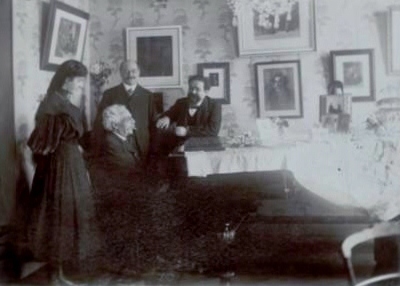
 Sansoni and Albéniz, 1909


Sansoni also "took Planté's advice,"[10] who was "considered ... the foremost French pianist" at the end of the 19th century.[11] The exact period of her studies is unknown, but his high regard for her and Albéniz is evident in a letter to French composer and music critic Henri Collet on the occasion of Albéniz's death: "One of his pupils, undoubtedly the most brilliant, Clara Sansoni, ... preserves with deep reverence the memory of her master, to whom she pays such great honor... ."[12]
Career
From 1906 onward, Sansoni performed regularly, primarily in Italy and Paris. While her repertoire spanned the standard piano literature, she held a particular affinity for Albéniz's Iberia.[9]
She initially presented this four-volume "suite of impressionistic pieces"[7] in excerpts across various stages, eventually performing it as a complete cycle for the first time in London to critical acclaim. At her London debut in March 1909, where she performed the then-largely unknown Iberia in "two divisions," she was praised for a style defined by "remarkable clarity and precision."[13] Following the 1909 concerts in Milan and Turin, the Italian press lauded her virtuosity for her interpretations of Beethoven, Schumann, and Albéniz. Writing in the Italian journal Ars et labor rivista mensile illustrata, contemporary critics highlighted her "exceptional dexterity", yet found her most "aesthetically appealing" quality to be her "clear and cheerful simplicity." In contrast, her performance of the "piano poem Iberia" was seen as a "dual revelation of both pianist and composer. Albéniz's originality – found in his unusual rhythms, timbres, and rapid transitions from Scapigliatura to the Classical style – was rendered by Sansoni with both courage and affection".[14] In February 1911, Sansoni performed Iberia in Barcelona, "after having previously surprised and enchanted France, Italy, England, and Belgium with it." The feminist Catalan magazine Feminal announced her upcoming recital in anticipation of Sansoni's "most perfect interpretation of Isaac Albéniz's work."[a]
Throughout a career spanning two decades, Sansoni continued to receive widespread acclaim, earning a reputation as a "magnificent performer and interpreter."[16] In the mid-1920s, Sansoni ceased her international performances for unknown reasons. Prior to this, her concerts had already become less frequent. This was presumably due to the travel restrictions of the First World War and its long-term effects, and reflected Sansoni's gradual withdrawal from concert halls.[17]
In 1960, she was mentioned in the UNESCO Bulletin No. 357 in honour of Albéniz. The bulletin listed her alongside prominent French pianists Marguerite Long, Blanche Selva, and Alfred Cortot, as well as Spanish virtuosos Joaquín Malats and Ricardo Viñes. These figures "were fascinated by the charm of his music and were the first to appreciate his genius and the meaning of his work."[b] While a private recording of works by Chopin, Beethoven and Albéniz from 1971 serves as a document of her piano style many years after the peak of her career,[c] no other recordings are known. Sansoni died in Florence on 23 April 1977.[17]
Impact and legacy
For her contemporaries, such as the German music critic and composer Walter Niemann, Sansoni represented the excellence of the "Spanish-French school (Albéniz, Planté)."[20]
Albéniz and Enrique Granados ushered in the "golden age" of Spanish piano music during the late 19th and early 20th centuries, turning away from the musical dominance of "Italianism."[21] They wove guitar techniques and folk rhythms into their piano compositions.[d] Planté, a main figure of the 19th-century French school, was known for his "very charming, shimmering sounds – the floating tone", which "built upon the style of Camille Saint-Saëns while simultaneously reflecting the ideals of the French harpsichordists: clarity, elegance, and expressiveness," without interpretative "excesses".[e]
Sansoni fused her teacher's influences into a unique style. In 1924, Italian critic Guido M. Gatti described her – "a pupil of Albéniz and Planté" – as "particularly outstanding" and "a serious player with great strength."[22]
Sansoni's historically documented interpretations of Albéniz remain recognised, particularly in 21st-century Spanish publications. In 2001, Spanish musicologist Jacinto Torres Mulas emphasised Albéniz's "tradición oral" ("oral tradition") – Sansoni learned directly from him and was present at the creation of Iberia´s fourth book, Cuarto Cuaderno.[f] Musicologist Justo Romero, writing in the Spanish magazine Scherzo, listed her among Albéniz's few direct students who "stand out" and became friends, alongside French composers René de Castéra and Déodat de Séverac. De Castéra arranged Iberia for two pianos, while de Séverac completed Navarra after Albéniz's death in 1909. Sansoni was noted as Albéniz's "interpreter."[24]
Clara Sansoni is remembered as an "outstanding student" of Albeniz,[8] embodying the "Albéniz-Planté" piano school with excellence and "honour".[20]
