Claw finding problem
From Wikipedia, the free encyclopedia
The claw finding problem is a classical problem in complexity theory, with several applications in cryptography. In short, given two functions f, g, viewed as oracles, the problem is to find x and y such as f(x) = g(y). The pair (x, y) is then called a claw. Some problems, especially in cryptography, are best solved when viewed as a claw finding problem, hence any algorithmic improvement to solving the claw finding problem provides a better attack on cryptographic primitives such as hash functions.
Let be finite sets, and , two functions. A pair is called a claw if . The claw finding problem is defined as to find such a claw, given that one exists.




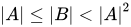
If we view as random functions, we expect a claw to exist iff . More accurately, there are exactly pairs of the form with ; the probability that such a pair is a claw is . So if , the expected number of claws is at least 1.







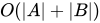

![{\displaystyle {\sqrt[{3}]{|A|\cdot |B|}}}](https://wikimedia.org/api/rest_v1/media/math/render/svg/b7b40553f26d1c77770648108e6cacc5388b49ec)