Clifton, Clatsop County, Oregon
From Wikipedia, the free encyclopedia
Clifton, Oregon | |
|---|---|
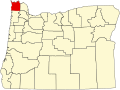
  Clifton Location within the state of Oregon  Clifton Clifton (the United States) | |
| Coordinates: 46°12′39″N 123°27′44″W / 46.21083°N 123.46222°W | |
| Country | United States |
| State | Oregon |
| County | Clatsop |
| Elevation | 10 ft (3.0 m) |
| Time zone | UTC-8 (Pacific (PST)) |
| • Summer (DST) | UTC-7 (PDT) |
| GNIS feature ID | 1119023[1] |
Clifton is an unincorporated community in Clatsop County, Oregon, United States.[1] It is located north of U.S. Route 30, about nine miles northwest of Westport on the south bank of the Columbia River.[2] It is on Clifton Channel across from Tenasillahe Island.[2]
Henry Harrison Hunt, an Oregon Trail pioneer of 1843, established a sawmill in the Clifton area in 1845.[3][4] By 1851 Hunt had moved on.[4] Later the site was an outpost for gillnetters.[5] In 1873 brothers James W. and Vincent Cook, pioneers of the Pacific Northwest salmon packing industry, established the second salmon cannery in Clatsop County there.[6][7][8] It is likely that settler Stephen G. Spear named his farm Clifton after the cliffs above the river before the land was owned by the Cook brothers.[6] Clifton post office was established in 1874, with Vincent Cook as the first postmaster.[6] The Astoria and South Coast Railway (later sold to the Spokane, Portland and Seattle Railway) was built through the area in 1898.[5][9]
The cannery employed Chinese workers, who canned the fish caught by Greek, Yugoslav, and Italian fishermen.[5] When the cannery closed in 1906, the Chinese left the town, leaving behind their bunkhouses (which no longer exist).[5] The other immigrants settled in different parts of town.[5] In its heyday, Clifton had two saloons, one with a combination skating rink and dance hall upstairs, two stores, a church, and a one-room schoolhouse.[5] The railroad tracks served as the main street.[5] In 1915 Clifton had a population of 200.[10] The dance hall burned down in 1921.[5] Clifton was not connected to U.S. 30 by road until 1937.[5] Instead, to leave town people either boated across the Columbia to Cathlamet, Washington, or took the train to Astoria or Portland.[5] In the early 20th century, there were five logging camps within three miles of Clifton and when the camps closed the loggers would move into town.[5] By 1930 all logging activity in the area had ceased.[5] Today Clifton is on the edge of the Clatsop State Forest.[2] Electricity did not reach Clifton until 1958.[5]