Clonsilla (civil parish)
From Wikipedia, the free encyclopedia
Clonsilla (Irish: Cluain Saileach) or "Clonsillagh"[9 1] is a civil parish and a townland located in the south-western corner of the modern county of Fingal, Ireland. The civil parish is part of the ancient barony of Castleknock. It is centred on the suburban village of Clonsilla.[1] In geology, the parish rests on a substratum of limestone and comprises 2943 statute acres, the whole of which is arable land. It is roughly bounded to the north by the old "Navan Road" – the modern N3; to the east by the civil parish of Castleknock; to the south by the River Liffey; to the south-east by the civil parish of Leixlip, chiefly in County Kildare, and to the north-west by the civil parish of Dunboyne in County Meath.
Ecclesiastical parishes
During the sixth century Saint Mochta, a bishop and the "last survivor of St. Patrick's disciples", founded a monastery at Clonsilla.[2] Mochta's mother, 'Cainer of Cluain-da-Saileach', was also mother to a number of other male saints.[3]
In 1831, there were 943 inhabitants in the parish of whom 770 were Catholics.[2] By 1837, according to Lewis' "Topography of Ireland", the parish contained 954 inhabitants. Lewis recorded that Luttrelestown demesne was the most notable seat in the parish. It was the residence of Col. Thomas White who was the second son of Luke White. Lewis observed that, "The demesne includes above 648 statute acres, exceedingly picturesque; the mansion is a noble building, in the castellated style.".[4]
The parish formerly belonged to the priory of Malvern, in Worcestershire. In 1773, an Act of the Privy Council united the parish with the curacies of Castleknock and Mulhuddart. In 1837, the tithes amounted to £240.[5]
Like all civil parishes, this civil parish is derived from, and co-extensive with a pre-existing ecclesiastical parish of the same name, as used in the Church of Ireland.[6] In the Archdiocese of Dublin, the parish is today united with Castleknock and Mulhuddart in the "Grouped Parishes of Castleknock and Mulhuddart with Clonsilla".[3 1] There are three extant church buildings that are still in use by the grouped parish:
- St. Brigid's, Castleknock, situated in the centre of Castleknock. The building - a listed national monument - was constructed in 1870.[5 1] It features a three-stage tower to the west gable with a Gothic tympanum at the entrance and a stained glass window by Harry Clarke that is dedicated to Saint Hubert.
- St. Thomas', Mulhuddart, situated on the Kilbride Road near Hollystown Golf Club. The building - a listed national monument - was constructed in 1870.[5 2] It features a polygonal bell tower in the south corner.
- St. Mary's, Clonsilla, situated at the western end of the Clonsilla Road near Clonsilla railway station. The building - a listed national monument - was constructed in 1846.[5 3] It features stained glass windows by Evie Hone.
In the Catholic Church, the territory of the civil parish is part of the Archdiocese of Dublin. It is currently divided between the following ecclesiastical parishes :
- "St. Mochta's", Porterstown.[2 1][3 2]
- "Mountview / Blakestown". The sole church building of the combined parishes is "St Philip, the Apostle", Mountview.[3 3] The church of "Mary of the Servants", Blakestown[3 4] was closed indefinitely on 7 January 2018.[2 2]
- "St. Ciarán's", Hartstown.[2 3][3 5]
History Gallery
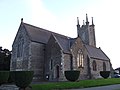 St. Bridget's church, Castleknock
 St. Mary's church, Clonsilla
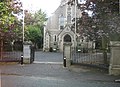 St. Mochta's parish church
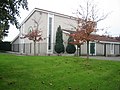 St. Ciaran's parish church at Hartstown


_-_20190914144927.jpg)
.jpg)

_-_20180916191228.jpg)


