Cluster labeling
From Wikipedia, the free encyclopedia
In natural language processing and information retrieval, cluster labeling is the problem of picking descriptive, human-readable labels for the clusters produced by a document clustering algorithm; standard clustering algorithms do not typically produce any such labels. Cluster labeling algorithms examine the contents of the documents per cluster to find a labeling that summarize the topic of each cluster and distinguish the clusters from each other.
Pointwise mutual information
Differential cluster labeling labels a cluster by comparing term distributions across clusters, using techniques also used for feature selection in document classification, such as mutual information and chi-squared feature selection. Terms having very low frequency are not the best in representing the whole cluster and can be omitted in labeling a cluster. By omitting those rare terms and using a differential test, one can achieve the best results with differential cluster labeling.[1]
In the fields of probability theory and information theory, mutual information measures the degree of dependence of two random variables. The mutual information of two variables X and Y is defined as:

where p(x, y) is the joint probability distribution of the two variables, p1(x) is the probability distribution of X, and p2(y) is the probability distribution of Y.
In the case of cluster labeling, the variable X is associated with membership in a cluster, and the variable Y is associated with the presence of a term.[2] Both variables can have values of 0 or 1, so the equation can be rewritten as follows:

In this case, p(C = 1) represents the probability that a randomly selected document is a member of a particular cluster, and p(C = 0) represents the probability that it isn't. Similarly, p(T = 1) represents the probability that a randomly selected document contains a given term, and p(T = 0) represents the probability that it doesn't. The joint probability distribution function p(C, T) represents the probability that two events occur simultaneously. For example, p(0, 0) is the probability that a document isn't a member of cluster c and doesn't contain term t; p(0, 1) is the probability that a document isn't a member of cluster C and does contain term T; and so on.
Chi-Squared Selection
The Pearson's chi-squared test can be used to calculate the probability that the occurrence of an event matches the initial expectations. In particular, it can be used to determine whether two events, A and B, are statistically independent. The value of the chi-squared statistic is:
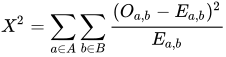
where Oa,b is the observed frequency of a and b co-occurring, and Ea,b is the expected frequency of co-occurrence.
In the case of cluster labeling, the variable A is associated with membership in a cluster, and the variable B is associated with the presence of a term. Both variables can have values of 0 or 1, so the equation can be rewritten as follows:
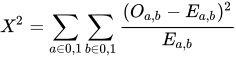
For example, O1,0 is the observed number of documents that are in a particular cluster but don't contain a certain term, and E1,0 is the expected number of documents that are in a particular cluster but don't contain a certain term. Our initial assumption is that the two events are independent, so the expected probabilities of co-occurrence can be calculated by multiplying individual probabilities:[3]
E1,0 = N * P(C = 1) * P(T = 0)
where N is the total number of documents in the collection.





